












Valintaopas
PLD905-25W-P vs SPL PL90: two 25 W class 905 nm pulsed laser diodes
A datasheet comparison of PLD905-25W-P and SPL PL90 covering power definitions, emitter geometry, drive current, voltage, test conditions and substitution limits.
Päivitetty 2026-11-16 · 3 min lukea
PLD905-25W-P and OSRAM SPL PL90 are both 905 nm short-pulse emitters in plastic packages, but the shared 25 W class label does not make them interchangeable. Their emitter structures, geometry, electrical operating points and datasheet conditions differ.
PLD905-25W-P is marketed as a 25 W part, while its characteristic table lists 29 W typical and 32.8 W maximum. SPL PL90 lists 25 W typical and 30 W maximum. Values taken under different conditions cannot be treated as a same-condition performance comparison.
Product: PLD905-25W-P.
Key comparison
| Parameter | PLD905-25W-P | SPL PL90 |
|---|---|---|
| Wavelength | 905 nm, 895-915 nm | 905 nm, 895-915 nm |
| Spectral width | 7 nm FWHM typical | 7 nm FWHM typical |
| Power definition | 25 W name; table 23.9 min / 29 typ / 32.8 max | 20 min / 25 typ / 30 max |
| Emitter | 70 x 10 um | 200 x 2 um |
| Divergence FWHM | 9 x 25 degrees typical | 11 x 25 degrees |
| Threshold current | 0.75 A typical | 0.75 A typical |
| Operating current | 11 A, 9-13 A | 30 A |
| Operating voltage | 9.4 V, 8.8-10 V | 4.3 V, 3.3-5.3 V |
| Standard repetition | 3 kHz | 1 kHz |
| Maximum pulse width / duty | 100 ns / 0.1% | 100 ns / 0.1% |
| Wavelength drift | 0.28 nm/K | 0.28 nm/K |
Emitter geometry
PLD905-25W-P uses three epitaxial stacked emitters and a 70 x 10 um emitting area. SPL PL90 uses a large optical cavity and a roughly 200 um lateral aperture. Those descriptions cannot be ranked by name alone.
The geometric products are about 700 um2 and 400 um2, but this is not effective emitting area and does not determine the final target spot. Collimation, far-field distribution, distance and alignment also matter. Use the spot-at-distance calculator for a first estimate.
Driver differences
PLD905-25W-P operates near 11 A and 9.4 V typical; SPL PL90 operates near 30 A and 4.3 V. A common driver is therefore not assumed:
- PLD needs higher compliance voltage and lower current.
- SPL needs lower voltage and higher pulse current.
- Loop inductance, switch voltage rating, connector drop and pulse probe bandwidth must be rechecked.
- The 1 kHz and 3 kHz reference conditions must be harmonised before comparing power and heating.
The product of typical current and voltage is only a scale check, not an efficiency measurement. Use the peak-power and average-power calculators to connect pulse width, energy and repetition rate.
Application fit
PLD905-25W-P lists handheld ranging, golf, hunting, construction measurement, UAV ranging/obstacle sensing and professional laser sensors. SPL PL90 lists range finding, security, illumination/ignition and test and measurement.
Application descriptions do not certify a finished product. Start with the LiDAR link-budget calculator, then include receiver sensitivity, target reflectance and ambient light.
Replacement checks
- Clarify the 25 W name, 29 W typical value and guaranteed procurement range.
- Compare current mechanical drawings, pin polarity, lead frame and emitter position.
- Measure optical power under identical pulse width, repetition, temperature and current.
- Measure voltage, current, edges, overshoot and reverse spikes on the real driver.
- Validate both axes of the far field and the collimated target-plane spot.
- Test power drift and life across temperature and repetition rate.
- Re-run complete-product laser-safety classification.
Conclusion: wavelength, spectral width, threshold current and temperature range are similar, but electrical operating points, emitter geometry and application fit differ. The PLD power definition must be clarified and a same-condition A/B test is required before substitution.
Tuotteet
Liittyvät tuotteet
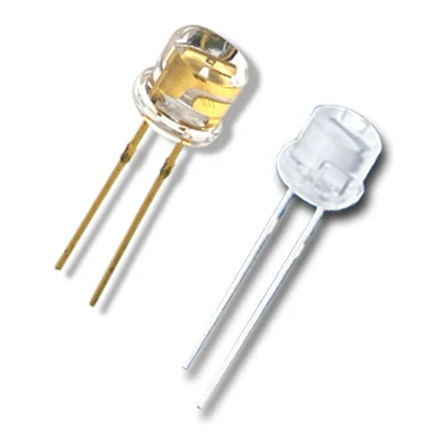 Muovimuovattu kotelo
PLD905-25W-P
25 W huippu, 905 nm, ei kollimoitu
Laskimet
Laske tällä tietolomakkeella
Jokainen alla oleva laskin avautuu tämän osan tietolehtinumeroilla jo täytettyinä, kenttien pyytämillä yksiköillä.
Pulssin huipputeho
Hetkellinen huipputeho pulssienergian ja pulssin leveyden perusteella.
Huipputeho 25 W · Pulssienergia 0.0025 mJ · Pulssin leveys 100 ns Laserin perusteetTyösykli & Lämpökuorma
Aikaosuus, jonka laseri on päällä, pulssin leveyden ja toistokertoimen perusteella.
Työjakso 0.1 % · Pulssin leveys 100 ns · Toistotaajuus 10 kHz Laserin perusteetKeskiteho
Jatkuva keskimääräisteho toistotaajuudesta ja pulssin energiamäärästä.
Energia per pulssi 0.0025 mJ · Toistotaajuus 10 kHz Laserin perusteetPistelaajuus etäisyydellä z
Säteen säde etäisyydellä z vyötäisestä.
Etäisyysmittaus & LiDARLiDAR linkkibudjetti
Arvioi vastaanottimella siepattu optinen teho.
Aiheeseen liittyvää luettavaa
785 nm monimoodinen homogenoitu kuitulaser: tasainen valotus, kokonaisaseman optiikka ja validointirajat
Käytännön opas 785 nm, 90 mW, 200/340 μm homogenoidulle kuitulaserille, kattaa valotuksen tasaisuuden, kokonaisaseman apuoptiikan, tehon budjetoinnin ja mittauksen.
Optiikka905 nm Raman DTS: insinööritoteutus ja validointiraportti
Täydellinen insinöörireitti 905 nm pulssipumpusta ja noin 870/943 nm Raman-kanavista kaksois-APD:n, synkronisen tiedon, erotushäviöiden korjauksen, lämpötilan käänteen, kalibroinnin ja prototyyppien validoinnin kautta.
Valintaopas905 nm vastaan 1535 nm vastaan 1550 nm: aallonpituuden valinta etäisyyden mittaukseen ja LiDAR:lle
Aaltopituusvalinta määrittää detektorisi, silmäturvallisuusluokkasi, maksimikäytettävän energiasi ja säänsuorituskykysi. Tässä on, miten kolme aluetta itse asiassa vertautuvat etäisyyden mittaustyöhön.