












선정 가이드
PLD905-25W-P vs SPL PL90: two 25 W class 905 nm pulsed laser diodes
A datasheet comparison of PLD905-25W-P and SPL PL90 covering power definitions, emitter geometry, drive current, voltage, test conditions and substitution limits.
갱신 2026-11-16 · 3 분 소요
PLD905-25W-P and OSRAM SPL PL90 are both 905 nm short-pulse emitters in plastic packages, but the shared 25 W class label does not make them interchangeable. Their emitter structures, geometry, electrical operating points and datasheet conditions differ.
PLD905-25W-P is marketed as a 25 W part, while its characteristic table lists 29 W typical and 32.8 W maximum. SPL PL90 lists 25 W typical and 30 W maximum. Values taken under different conditions cannot be treated as a same-condition performance comparison.
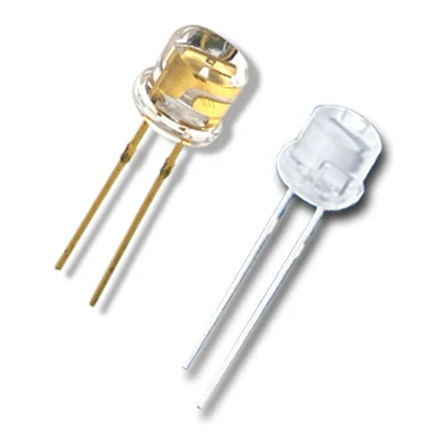
Product: PLD905-25W-P.
Key comparison
| Parameter | PLD905-25W-P | SPL PL90 |
|---|---|---|
| Wavelength | 905 nm, 895-915 nm | 905 nm, 895-915 nm |
| Spectral width | 7 nm FWHM typical | 7 nm FWHM typical |
| Power definition | 25 W name; table 23.9 min / 29 typ / 32.8 max | 20 min / 25 typ / 30 max |
| Emitter | 70 x 10 um | 200 x 2 um |
| Divergence FWHM | 9 x 25 degrees typical | 11 x 25 degrees |
| Threshold current | 0.75 A typical | 0.75 A typical |
| Operating current | 11 A, 9-13 A | 30 A |
| Operating voltage | 9.4 V, 8.8-10 V | 4.3 V, 3.3-5.3 V |
| Standard repetition | 3 kHz | 1 kHz |
| Maximum pulse width / duty | 100 ns / 0.1% | 100 ns / 0.1% |
| Wavelength drift | 0.28 nm/K | 0.28 nm/K |
Emitter geometry
PLD905-25W-P uses three epitaxial stacked emitters and a 70 x 10 um emitting area. SPL PL90 uses a large optical cavity and a roughly 200 um lateral aperture. Those descriptions cannot be ranked by name alone.
The geometric products are about 700 um2 and 400 um2, but this is not effective emitting area and does not determine the final target spot. Collimation, far-field distribution, distance and alignment also matter. Use the spot-at-distance calculator for a first estimate.
Driver differences
PLD905-25W-P operates near 11 A and 9.4 V typical; SPL PL90 operates near 30 A and 4.3 V. A common driver is therefore not assumed:
- PLD needs higher compliance voltage and lower current.
- SPL needs lower voltage and higher pulse current.
- Loop inductance, switch voltage rating, connector drop and pulse probe bandwidth must be rechecked.
- The 1 kHz and 3 kHz reference conditions must be harmonised before comparing power and heating.
The product of typical current and voltage is only a scale check, not an efficiency measurement. Use the peak-power and average-power calculators to connect pulse width, energy and repetition rate.
Application fit
PLD905-25W-P lists handheld ranging, golf, hunting, construction measurement, UAV ranging/obstacle sensing and professional laser sensors. SPL PL90 lists range finding, security, illumination/ignition and test and measurement.
Application descriptions do not certify a finished product. Start with the LiDAR link-budget calculator, then include receiver sensitivity, target reflectance and ambient light.
Replacement checks
- Clarify the 25 W name, 29 W typical value and guaranteed procurement range.
- Compare current mechanical drawings, pin polarity, lead frame and emitter position.
- Measure optical power under identical pulse width, repetition, temperature and current.
- Measure voltage, current, edges, overshoot and reverse spikes on the real driver.
- Validate both axes of the far field and the collimated target-plane spot.
- Test power drift and life across temperature and repetition rate.
- Re-run complete-product laser-safety classification.
Conclusion: wavelength, spectral width, threshold current and temperature range are similar, but electrical operating points, emitter geometry and application fit differ. The PLD power definition must be clarified and a same-condition A/B test is required before substitution.
제품
관련 제품
계산기
이 데이터시트 값으로 계산
아래 계산기는 이 부품의 데이터시트 값이 각 입력란의 단위로 이미 채워진 상태로 열립니다.
펄스 피크 출력
펄스 피크 출력을(를) 계산하고 입력값이 결과에 미치는 영향을 확인하는 엔지니어링 계산기입니다.
피크 출력 25 W · 펄스 에너지 0.0025 mJ · 펄스 폭 100 ns 레이저 기초듀티 사이클 및 열 부하
듀티 사이클 및 열 부하을(를) 계산하고 입력값이 결과에 미치는 영향을 확인하는 엔지니어링 계산기입니다.
듀티 사이클 0.1 % · 펄스 폭 100 ns · 반복률 10 kHz 레이저 기초평균 출력
평균 출력을(를) 계산하고 입력값이 결과에 미치는 영향을 확인하는 엔지니어링 계산기입니다.
펄스당 에너지 0.0025 mJ · 반복률 10 kHz 레이저 기초거리 z에서의 스폿 크기
거리 z에서의 스폿 크기을(를) 계산하고 입력값이 결과에 미치는 영향을 확인하는 엔지니어링 계산기입니다.
거리측정 및 LiDARLiDAR 링크 버짓
LiDAR 링크 버짓을(를) 계산하고 입력값이 결과에 미치는 영향을 확인하는 엔지니어링 계산기입니다.
관련 자료
785 nm 다중모드 균질화-섬유 레이저: 균일한 조명, 토털 스테이션 광학 장치 및 검증 제한
조명 균일성, 토털 스테이션 보조 광학 장치, 전력 예산 및 측정을 다루는 785 nm, 90 mW, 200/340 um 균질화-섬유 레이저 실용 가이드.
광학905 nm 라만 DTS: 엔지니어링 구현 및 검증 보고서
905 nm 펄스 펌프와 약 870/943 nm 라만 채널을 거쳐 듀얼 APD, 동기화 수집, 차동 손실 보정, 온도 역전, 교정 및 프로토타입 검증까지의 완전한 엔지니어링 경로.
선정 가이드905 nm, 1535 nm, 1550 nm: 거리측정과 LiDAR의 파장 선택
파장은 사용할 검출기, 눈 안전 등급, 허용 가능한 최대 에너지, 악천후 성능을 결정합니다. 세 대역이 거리측정에서 실제로 어떻게 다른지 정리합니다.