












Guide de sélection
PLD905-25W-P vs SPL PL90: two 25 W class 905 nm pulsed laser diodes
A datasheet comparison of PLD905-25W-P and SPL PL90 covering power definitions, emitter geometry, drive current, voltage, test conditions and substitution limits.
Mis à jour 2026-11-16 · 3 min de lecture
PLD905-25W-P and OSRAM SPL PL90 are both 905 nm short-pulse emitters in plastic packages, but the shared 25 W class label does not make them interchangeable. Their emitter structures, geometry, electrical operating points and datasheet conditions differ.
PLD905-25W-P is marketed as a 25 W part, while its characteristic table lists 29 W typical and 32.8 W maximum. SPL PL90 lists 25 W typical and 30 W maximum. Values taken under different conditions cannot be treated as a same-condition performance comparison.
Product: PLD905-25W-P.
Key comparison
| Parameter | PLD905-25W-P | SPL PL90 |
|---|---|---|
| Wavelength | 905 nm, 895-915 nm | 905 nm, 895-915 nm |
| Spectral width | 7 nm FWHM typical | 7 nm FWHM typical |
| Power definition | 25 W name; table 23.9 min / 29 typ / 32.8 max | 20 min / 25 typ / 30 max |
| Emitter | 70 x 10 um | 200 x 2 um |
| Divergence FWHM | 9 x 25 degrees typical | 11 x 25 degrees |
| Threshold current | 0.75 A typical | 0.75 A typical |
| Operating current | 11 A, 9-13 A | 30 A |
| Operating voltage | 9.4 V, 8.8-10 V | 4.3 V, 3.3-5.3 V |
| Standard repetition | 3 kHz | 1 kHz |
| Maximum pulse width / duty | 100 ns / 0.1% | 100 ns / 0.1% |
| Wavelength drift | 0.28 nm/K | 0.28 nm/K |
Emitter geometry
PLD905-25W-P uses three epitaxial stacked emitters and a 70 x 10 um emitting area. SPL PL90 uses a large optical cavity and a roughly 200 um lateral aperture. Those descriptions cannot be ranked by name alone.
The geometric products are about 700 um2 and 400 um2, but this is not effective emitting area and does not determine the final target spot. Collimation, far-field distribution, distance and alignment also matter. Use the spot-at-distance calculator for a first estimate.
Driver differences
PLD905-25W-P operates near 11 A and 9.4 V typical; SPL PL90 operates near 30 A and 4.3 V. A common driver is therefore not assumed:
- PLD needs higher compliance voltage and lower current.
- SPL needs lower voltage and higher pulse current.
- Loop inductance, switch voltage rating, connector drop and pulse probe bandwidth must be rechecked.
- The 1 kHz and 3 kHz reference conditions must be harmonised before comparing power and heating.
The product of typical current and voltage is only a scale check, not an efficiency measurement. Use the peak-power and average-power calculators to connect pulse width, energy and repetition rate.
Application fit
PLD905-25W-P lists handheld ranging, golf, hunting, construction measurement, UAV ranging/obstacle sensing and professional laser sensors. SPL PL90 lists range finding, security, illumination/ignition and test and measurement.
Application descriptions do not certify a finished product. Start with the LiDAR link-budget calculator, then include receiver sensitivity, target reflectance and ambient light.
Replacement checks
- Clarify the 25 W name, 29 W typical value and guaranteed procurement range.
- Compare current mechanical drawings, pin polarity, lead frame and emitter position.
- Measure optical power under identical pulse width, repetition, temperature and current.
- Measure voltage, current, edges, overshoot and reverse spikes on the real driver.
- Validate both axes of the far field and the collimated target-plane spot.
- Test power drift and life across temperature and repetition rate.
- Re-run complete-product laser-safety classification.
Conclusion: wavelength, spectral width, threshold current and temperature range are similar, but electrical operating points, emitter geometry and application fit differ. The PLD power definition must be clarified and a same-condition A/B test is required before substitution.
Produits
Produits associés
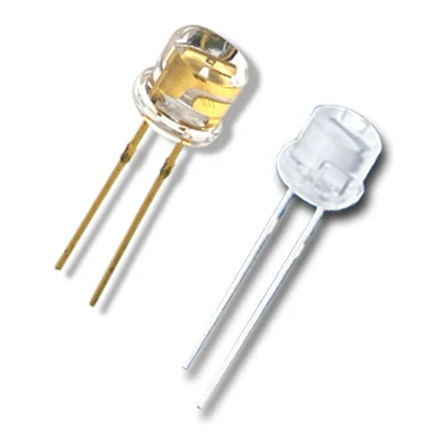 Boîtier plastique moulé
PLD905-25W-P
905 nm, 25 W crête, non collimaté
Calculateurs
Calculer avec cette fiche technique
Chaque calculateur ci-dessous s'ouvre avec les valeurs de la fiche de cette pièce déjà saisies, dans les unités demandées par les champs.
Puissance crête d'impulsion
Puissance crête instantanée à partir de l'énergie et de la largeur d'impulsion.
Puissance crête 25 W · Énergie par impulsion 0.0025 mJ · Largeur d'impulsion 100 ns Fondamentaux du laserRapport cyclique et charge thermique
Fraction du temps pendant laquelle le laser est actif, à partir de la largeur d'impulsion et de la fréquence de répétition.
Rapport cyclique 0.1 % · Largeur d'impulsion 100 ns · Fréquence de répétition 10 kHz Fondamentaux du laserPuissance moyenne
Puissance moyenne continue à partir de la fréquence de répétition et de l'énergie par impulsion.
Énergie par impulsion 0.0025 mJ · Fréquence de répétition 10 kHz Fondamentaux du laserTaille du spot à la distance z
Rayon du faisceau à une distance z de la taille de mode.
Télémétrie et LiDARBilan de liaison LiDAR
Estime la puissance optique captée au récepteur.
Lectures associées
Laser à fibre homogénéisée multimode 785 nm : illumination uniforme, optique de station totale et limites de validation
Guide pratique d'un laser à fibre homogénéisée 785 nm, 90 mW, 200/340 um, couvrant l'uniformité de l'illumination, l'optique auxiliaire de station totale, le budget de puissance et la mesure.
OptiqueDTS Raman 905 nm : rapport de mise en œuvre et de validation en ingénierie
Un parcours complet en ingénierie à partir d'une pompe pulsée de 905 nm et de canaux Raman d'environ 870/943 nm à travers des APD doubles, acquisition synchrone, correction de perte différentielle, inversion de température, étalonnage et validation du prototype.
Guide de sélection905 nm, 1535 nm ou 1550 nm : choisir une longueur d'onde pour la télémétrie et le LiDAR
Le choix de la longueur d'onde détermine le détecteur, la classe de sécurité oculaire, l'énergie maximale utilisable et le comportement par mauvais temps. Voici comment les trois bandes se comparent réellement pour la télémétrie.