












Guia de seleção
PLD905-25W-P vs SPL PL90: two 25 W class 905 nm pulsed laser diodes
A datasheet comparison of PLD905-25W-P and SPL PL90 covering power definitions, emitter geometry, drive current, voltage, test conditions and substitution limits.
Atualizado 2026-11-16 · 3 min de leitura
PLD905-25W-P and OSRAM SPL PL90 are both 905 nm short-pulse emitters in plastic packages, but the shared 25 W class label does not make them interchangeable. Their emitter structures, geometry, electrical operating points and datasheet conditions differ.
PLD905-25W-P is marketed as a 25 W part, while its characteristic table lists 29 W typical and 32.8 W maximum. SPL PL90 lists 25 W typical and 30 W maximum. Values taken under different conditions cannot be treated as a same-condition performance comparison.
Product: PLD905-25W-P.
Key comparison
| Parameter | PLD905-25W-P | SPL PL90 |
|---|---|---|
| Wavelength | 905 nm, 895-915 nm | 905 nm, 895-915 nm |
| Spectral width | 7 nm FWHM typical | 7 nm FWHM typical |
| Power definition | 25 W name; table 23.9 min / 29 typ / 32.8 max | 20 min / 25 typ / 30 max |
| Emitter | 70 x 10 um | 200 x 2 um |
| Divergence FWHM | 9 x 25 degrees typical | 11 x 25 degrees |
| Threshold current | 0.75 A typical | 0.75 A typical |
| Operating current | 11 A, 9-13 A | 30 A |
| Operating voltage | 9.4 V, 8.8-10 V | 4.3 V, 3.3-5.3 V |
| Standard repetition | 3 kHz | 1 kHz |
| Maximum pulse width / duty | 100 ns / 0.1% | 100 ns / 0.1% |
| Wavelength drift | 0.28 nm/K | 0.28 nm/K |
Emitter geometry
PLD905-25W-P uses three epitaxial stacked emitters and a 70 x 10 um emitting area. SPL PL90 uses a large optical cavity and a roughly 200 um lateral aperture. Those descriptions cannot be ranked by name alone.
The geometric products are about 700 um2 and 400 um2, but this is not effective emitting area and does not determine the final target spot. Collimation, far-field distribution, distance and alignment also matter. Use the spot-at-distance calculator for a first estimate.
Driver differences
PLD905-25W-P operates near 11 A and 9.4 V typical; SPL PL90 operates near 30 A and 4.3 V. A common driver is therefore not assumed:
- PLD needs higher compliance voltage and lower current.
- SPL needs lower voltage and higher pulse current.
- Loop inductance, switch voltage rating, connector drop and pulse probe bandwidth must be rechecked.
- The 1 kHz and 3 kHz reference conditions must be harmonised before comparing power and heating.
The product of typical current and voltage is only a scale check, not an efficiency measurement. Use the peak-power and average-power calculators to connect pulse width, energy and repetition rate.
Application fit
PLD905-25W-P lists handheld ranging, golf, hunting, construction measurement, UAV ranging/obstacle sensing and professional laser sensors. SPL PL90 lists range finding, security, illumination/ignition and test and measurement.
Application descriptions do not certify a finished product. Start with the LiDAR link-budget calculator, then include receiver sensitivity, target reflectance and ambient light.
Replacement checks
- Clarify the 25 W name, 29 W typical value and guaranteed procurement range.
- Compare current mechanical drawings, pin polarity, lead frame and emitter position.
- Measure optical power under identical pulse width, repetition, temperature and current.
- Measure voltage, current, edges, overshoot and reverse spikes on the real driver.
- Validate both axes of the far field and the collimated target-plane spot.
- Test power drift and life across temperature and repetition rate.
- Re-run complete-product laser-safety classification.
Conclusion: wavelength, spectral width, threshold current and temperature range are similar, but electrical operating points, emitter geometry and application fit differ. The PLD power definition must be clarified and a same-condition A/B test is required before substitution.
Produtos
Produtos relacionados
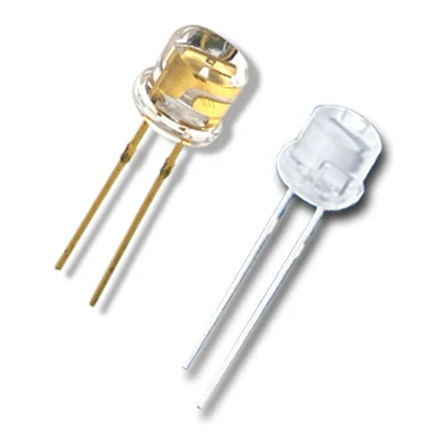 Encapsulamento plástico moldado
PLD905-25W-P
905 nm, pulsado, SMD plástico
Calculadoras
Calcule com esta folha de dados
Cada calculadora abaixo abre com os valores da ficha desta peça já preenchidos, nas unidades pedidas pelos campos.
Potência de pico do pulso
Calculadora de engenharia para determinar potência de pico do pulso e avaliar o efeito dos dados de entrada no resultado.
Potência de pico 25 W · Pulse energy 0.0025 mJ · Pulse width 100 ns Fundamentos do laserCiclo de trabalho e carga térmica
Calculadora de engenharia para determinar ciclo de trabalho e carga térmica e avaliar o efeito dos dados de entrada no resultado.
Ciclo de trabalho 0.1 % · Pulse width 100 ns · Repetition rate 10 kHz Fundamentos do laserPotência média
Calculadora de engenharia para determinar potência média e avaliar o efeito dos dados de entrada no resultado.
Energia por pulso 0.0025 mJ · Repetition rate 10 kHz Fundamentos do laserTamanho do ponto à distância z
Calculadora de engenharia para determinar tamanho do ponto à distância z e avaliar o efeito dos dados de entrada no resultado.
Medição de distância e LiDAROrçamento de enlace LiDAR
Calculadora de engenharia para determinar orçamento de enlace lidar e avaliar o efeito dos dados de entrada no resultado.
Leituras relacionadas
Laser de fibra homogeneizada multimodo de 785 nm: iluminação uniforme, óptica de estação total e limites de validação
Guia prático de um laser de fibra homogeneizada de 785 nm, 90 mW, 200/340 um, abordando uniformidade de iluminação, óptica auxiliar de estação total, orçamento de potência e medição.
Óptica905 nm Raman DTS: relatório de implementação e validação de engenharia
Uma rota completa de engenharia a partir de uma bomba pulsada de 905 nm e aproximadamente canais Raman de 870/943 nm através de APDs duplos, aquisição síncrona, correção de perda diferencial, inversão de temperatura, calibração e validação de protótipo.
Guia de seleção905 nm, 1535 nm e 1550 nm: como escolher o comprimento de onda para medição de distância e LiDAR
O comprimento de onda define o detector, a classe de segurança ocular, a energia máxima utilizável e o desempenho sob condições climáticas. Veja como as três faixas se comparam.