












Seçim kılavuzu
PLD905-25W-P vs SPL PL90: two 25 W class 905 nm pulsed laser diodes
A datasheet comparison of PLD905-25W-P and SPL PL90 covering power definitions, emitter geometry, drive current, voltage, test conditions and substitution limits.
Güncellendi 2026-11-16 · 3 dk okuma
PLD905-25W-P and OSRAM SPL PL90 are both 905 nm short-pulse emitters in plastic packages, but the shared 25 W class label does not make them interchangeable. Their emitter structures, geometry, electrical operating points and datasheet conditions differ.
PLD905-25W-P is marketed as a 25 W part, while its characteristic table lists 29 W typical and 32.8 W maximum. SPL PL90 lists 25 W typical and 30 W maximum. Values taken under different conditions cannot be treated as a same-condition performance comparison.
Product: PLD905-25W-P.
Key comparison
| Parameter | PLD905-25W-P | SPL PL90 |
|---|---|---|
| Wavelength | 905 nm, 895-915 nm | 905 nm, 895-915 nm |
| Spectral width | 7 nm FWHM typical | 7 nm FWHM typical |
| Power definition | 25 W name; table 23.9 min / 29 typ / 32.8 max | 20 min / 25 typ / 30 max |
| Emitter | 70 x 10 um | 200 x 2 um |
| Divergence FWHM | 9 x 25 degrees typical | 11 x 25 degrees |
| Threshold current | 0.75 A typical | 0.75 A typical |
| Operating current | 11 A, 9-13 A | 30 A |
| Operating voltage | 9.4 V, 8.8-10 V | 4.3 V, 3.3-5.3 V |
| Standard repetition | 3 kHz | 1 kHz |
| Maximum pulse width / duty | 100 ns / 0.1% | 100 ns / 0.1% |
| Wavelength drift | 0.28 nm/K | 0.28 nm/K |
Emitter geometry
PLD905-25W-P uses three epitaxial stacked emitters and a 70 x 10 um emitting area. SPL PL90 uses a large optical cavity and a roughly 200 um lateral aperture. Those descriptions cannot be ranked by name alone.
The geometric products are about 700 um2 and 400 um2, but this is not effective emitting area and does not determine the final target spot. Collimation, far-field distribution, distance and alignment also matter. Use the spot-at-distance calculator for a first estimate.
Driver differences
PLD905-25W-P operates near 11 A and 9.4 V typical; SPL PL90 operates near 30 A and 4.3 V. A common driver is therefore not assumed:
- PLD needs higher compliance voltage and lower current.
- SPL needs lower voltage and higher pulse current.
- Loop inductance, switch voltage rating, connector drop and pulse probe bandwidth must be rechecked.
- The 1 kHz and 3 kHz reference conditions must be harmonised before comparing power and heating.
The product of typical current and voltage is only a scale check, not an efficiency measurement. Use the peak-power and average-power calculators to connect pulse width, energy and repetition rate.
Application fit
PLD905-25W-P lists handheld ranging, golf, hunting, construction measurement, UAV ranging/obstacle sensing and professional laser sensors. SPL PL90 lists range finding, security, illumination/ignition and test and measurement.
Application descriptions do not certify a finished product. Start with the LiDAR link-budget calculator, then include receiver sensitivity, target reflectance and ambient light.
Replacement checks
- Clarify the 25 W name, 29 W typical value and guaranteed procurement range.
- Compare current mechanical drawings, pin polarity, lead frame and emitter position.
- Measure optical power under identical pulse width, repetition, temperature and current.
- Measure voltage, current, edges, overshoot and reverse spikes on the real driver.
- Validate both axes of the far field and the collimated target-plane spot.
- Test power drift and life across temperature and repetition rate.
- Re-run complete-product laser-safety classification.
Conclusion: wavelength, spectral width, threshold current and temperature range are similar, but electrical operating points, emitter geometry and application fit differ. The PLD power definition must be clarified and a same-condition A/B test is required before substitution.
Ürünler
İlgili ürünler
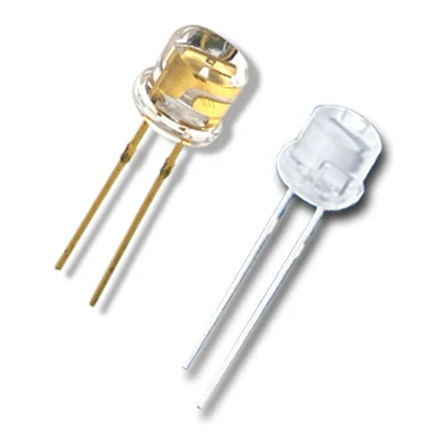 Dökme plastik kılıf
PLD905-25W-P
905 nm, 25 W tepe, kolimasyonsuz
Hesaplayıcılar
Bu veri sayfasıyla hesaplayın
Aşağıdaki her hesaplayıcı, bu parçanın veri sayfası değerleri alanların istediği birimlerde önceden doldurulmuş olarak açılır.
Darbe Tepe Gücü
Mühendislik hesaplayıcısı: darbe tepe gücü hesaplar ve girdilerin sonuç üzerindeki etkisini değerlendirir.
Tepe güç 25 W · Darbe enerjisi 0.0025 mJ · Darbe genişliği 100 ns Lazer TemelleriGörev Döngüsü ve Isıl Yük
Mühendislik hesaplayıcısı: görev döngüsü ve isıl yük hesaplar ve girdilerin sonuç üzerindeki etkisini değerlendirir.
Görev döngüsü 0.1 % · Darbe genişliği 100 ns · Tekrar hızı 10 kHz Lazer TemelleriOrtalama Güç
Mühendislik hesaplayıcısı: ortalama güç hesaplar ve girdilerin sonuç üzerindeki etkisini değerlendirir.
Darbe başına enerji 0.0025 mJ · Tekrar hızı 10 kHz Lazer Temelleriz Mesafesindeki Nokta Boyutu
Mühendislik hesaplayıcısı: z mesafesindeki nokta boyutu hesaplar ve girdilerin sonuç üzerindeki etkisini değerlendirir.
Mesafe Ölçümü ve LiDARLiDAR Bağlantı Bütçesi
Mühendislik hesaplayıcısı: lidar bağlantı bütçesi hesaplar ve girdilerin sonuç üzerindeki etkisini değerlendirir.
İlgili okumalar
785 nm multimod homogenize-fiber lazer: uniform aydınlatma, total-station optiği ve doğrulama limitleri
Aydınlatma uniformluğunu, total-station yardımcı optiğini, güç bütçelemesini ve ölçümü kapsayan 785 nm, 90 mW, 200/340 um homogenize-fiber lazere pratik bir rehber.
Optik905 nm Raman DTS: mühendislik uygulama ve doğrulama raporu
905 nm darbeli pompa ve yaklaşık 870/943 nm Raman kanalları üzerinden çift APD, eşzamanlı edinim, diferansiyel kayıp düzeltmesi, sıcaklık ters çevirme, kalibrasyon ve prototip doğrulaması içeren eksiksiz bir mühendislik yolu.
Seçim kılavuzu905 nm, 1535 nm ve 1550 nm: mesafe ölçümü ve LiDAR için dalga boyu seçimi
Dalga boyu kararı dedektörünüzü, göz güvenliği sınıfınızı, kullanabileceğiniz en yüksek enerjiyi ve hava koşullarındaki performansınızı belirler. Üç bandın mesafe ölçümünde gerçekte nasıl karşılaştığını açıklıyoruz.