












Guía de selección
PLD905-25W-P vs SPL PL90: two 25 W class 905 nm pulsed laser diodes
A datasheet comparison of PLD905-25W-P and SPL PL90 covering power definitions, emitter geometry, drive current, voltage, test conditions and substitution limits.
Actualizado 2026-11-16 · 3 min de lectura
PLD905-25W-P and OSRAM SPL PL90 are both 905 nm short-pulse emitters in plastic packages, but the shared 25 W class label does not make them interchangeable. Their emitter structures, geometry, electrical operating points and datasheet conditions differ.
PLD905-25W-P is marketed as a 25 W part, while its characteristic table lists 29 W typical and 32.8 W maximum. SPL PL90 lists 25 W typical and 30 W maximum. Values taken under different conditions cannot be treated as a same-condition performance comparison.
Product: PLD905-25W-P.
Key comparison
| Parameter | PLD905-25W-P | SPL PL90 |
|---|---|---|
| Wavelength | 905 nm, 895-915 nm | 905 nm, 895-915 nm |
| Spectral width | 7 nm FWHM typical | 7 nm FWHM typical |
| Power definition | 25 W name; table 23.9 min / 29 typ / 32.8 max | 20 min / 25 typ / 30 max |
| Emitter | 70 x 10 um | 200 x 2 um |
| Divergence FWHM | 9 x 25 degrees typical | 11 x 25 degrees |
| Threshold current | 0.75 A typical | 0.75 A typical |
| Operating current | 11 A, 9-13 A | 30 A |
| Operating voltage | 9.4 V, 8.8-10 V | 4.3 V, 3.3-5.3 V |
| Standard repetition | 3 kHz | 1 kHz |
| Maximum pulse width / duty | 100 ns / 0.1% | 100 ns / 0.1% |
| Wavelength drift | 0.28 nm/K | 0.28 nm/K |
Emitter geometry
PLD905-25W-P uses three epitaxial stacked emitters and a 70 x 10 um emitting area. SPL PL90 uses a large optical cavity and a roughly 200 um lateral aperture. Those descriptions cannot be ranked by name alone.
The geometric products are about 700 um2 and 400 um2, but this is not effective emitting area and does not determine the final target spot. Collimation, far-field distribution, distance and alignment also matter. Use the spot-at-distance calculator for a first estimate.
Driver differences
PLD905-25W-P operates near 11 A and 9.4 V typical; SPL PL90 operates near 30 A and 4.3 V. A common driver is therefore not assumed:
- PLD needs higher compliance voltage and lower current.
- SPL needs lower voltage and higher pulse current.
- Loop inductance, switch voltage rating, connector drop and pulse probe bandwidth must be rechecked.
- The 1 kHz and 3 kHz reference conditions must be harmonised before comparing power and heating.
The product of typical current and voltage is only a scale check, not an efficiency measurement. Use the peak-power and average-power calculators to connect pulse width, energy and repetition rate.
Application fit
PLD905-25W-P lists handheld ranging, golf, hunting, construction measurement, UAV ranging/obstacle sensing and professional laser sensors. SPL PL90 lists range finding, security, illumination/ignition and test and measurement.
Application descriptions do not certify a finished product. Start with the LiDAR link-budget calculator, then include receiver sensitivity, target reflectance and ambient light.
Replacement checks
- Clarify the 25 W name, 29 W typical value and guaranteed procurement range.
- Compare current mechanical drawings, pin polarity, lead frame and emitter position.
- Measure optical power under identical pulse width, repetition, temperature and current.
- Measure voltage, current, edges, overshoot and reverse spikes on the real driver.
- Validate both axes of the far field and the collimated target-plane spot.
- Test power drift and life across temperature and repetition rate.
- Re-run complete-product laser-safety classification.
Conclusion: wavelength, spectral width, threshold current and temperature range are similar, but electrical operating points, emitter geometry and application fit differ. The PLD power definition must be clarified and a same-condition A/B test is required before substitution.
Productos
Productos relacionados
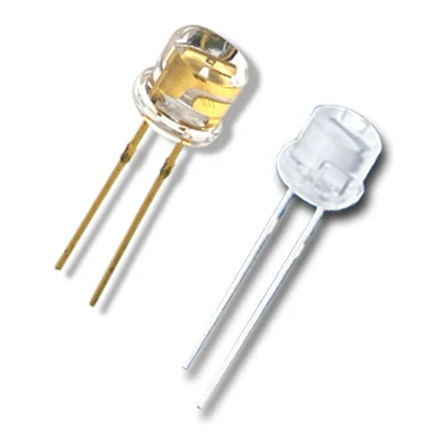 Encapsulado plástico moldeado
PLD905-25W-P
25 W pico, 905 nm, sin colimar
Calculadoras
Calcular con esta hoja de datos
Cada calculadora de abajo se abre con los valores de la ficha de esta pieza ya rellenados, en las unidades que piden los campos.
Potencia pico de pulso
Potencia pico instantánea a partir de la energía y la anchura del pulso.
Potencia pico 25 W · Energía de pulso 0.0025 mJ · Anchura de pulso 100 ns Fundamentos del láserCiclo de trabajo y carga térmica
Fracción de tiempo que el láser está encendido, a partir de la anchura de pulso y la frecuencia de repetición.
Ciclo de trabajo 0.1 % · Anchura de pulso 100 ns · Frecuencia de repetición 10 kHz Fundamentos del láserPotencia media
Potencia media continua a partir de la frecuencia de repetición y la energía por pulso.
Energía por pulso 0.0025 mJ · Frecuencia de repetición 10 kHz Fundamentos del láserTamaño de punto a distancia z
Radio del haz a una distancia z desde la cintura.
Medición y LiDARPresupuesto de enlace LiDAR
Estima la potencia óptica captada en el receptor.
Lecturas relacionadas
Láser de fibra homogeneizada multimodo de 785 nm: iluminación uniforme, óptica de estación total y límites de validación
Guía práctica de un láser de fibra homogeneizada de 785 nm, 90 mW, 200/340 um, que abarca uniformidad de iluminación, óptica auxiliar de estación total, presupuesto de potencia y medición.
Óptica905 nm Raman DTS: informe de implementación y validación de ingeniería
Una ruta completa de ingeniería desde una bomba pulsada de 905 nm y aproximadamente canales Raman de 870/943 nm a través de APD duales, adquisición síncrona, corrección de pérdida diferencial, inversión de temperatura, calibración y validación de prototipo.
Guía de selección905 nm frente a 1535 nm frente a 1550 nm: elegir una longitud de onda para medición de distancia y LiDAR
La decisión de longitud de onda fija tu detector, tu clase de seguridad ocular, tu energía máxima utilizable y tu rendimiento con mal tiempo. Así se comparan realmente las tres bandas para aplicaciones de medición.