












選定ガイド
PLD905-25W-P vs SPL PL90: two 25 W class 905 nm pulsed laser diodes
A datasheet comparison of PLD905-25W-P and SPL PL90 covering power definitions, emitter geometry, drive current, voltage, test conditions and substitution limits.
更新 2026-11-16 · 3 分で読めます
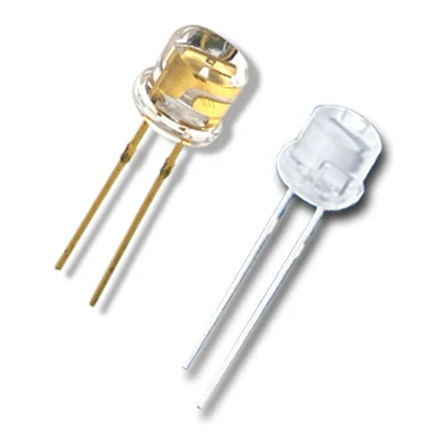
PLD905-25W-P and OSRAM SPL PL90 are both 905 nm short-pulse emitters in plastic packages, but the shared 25 W class label does not make them interchangeable. Their emitter structures, geometry, electrical operating points and datasheet conditions differ.
PLD905-25W-P is marketed as a 25 W part, while its characteristic table lists 29 W typical and 32.8 W maximum. SPL PL90 lists 25 W typical and 30 W maximum. Values taken under different conditions cannot be treated as a same-condition performance comparison.
Product: PLD905-25W-P.
Key comparison
| Parameter | PLD905-25W-P | SPL PL90 |
|---|---|---|
| Wavelength | 905 nm, 895-915 nm | 905 nm, 895-915 nm |
| Spectral width | 7 nm FWHM typical | 7 nm FWHM typical |
| Power definition | 25 W name; table 23.9 min / 29 typ / 32.8 max | 20 min / 25 typ / 30 max |
| Emitter | 70 x 10 um | 200 x 2 um |
| Divergence FWHM | 9 x 25 degrees typical | 11 x 25 degrees |
| Threshold current | 0.75 A typical | 0.75 A typical |
| Operating current | 11 A, 9-13 A | 30 A |
| Operating voltage | 9.4 V, 8.8-10 V | 4.3 V, 3.3-5.3 V |
| Standard repetition | 3 kHz | 1 kHz |
| Maximum pulse width / duty | 100 ns / 0.1% | 100 ns / 0.1% |
| Wavelength drift | 0.28 nm/K | 0.28 nm/K |
Emitter geometry
PLD905-25W-P uses three epitaxial stacked emitters and a 70 x 10 um emitting area. SPL PL90 uses a large optical cavity and a roughly 200 um lateral aperture. Those descriptions cannot be ranked by name alone.
The geometric products are about 700 um2 and 400 um2, but this is not effective emitting area and does not determine the final target spot. Collimation, far-field distribution, distance and alignment also matter. Use the spot-at-distance calculator for a first estimate.
Driver differences
PLD905-25W-P operates near 11 A and 9.4 V typical; SPL PL90 operates near 30 A and 4.3 V. A common driver is therefore not assumed:
- PLD needs higher compliance voltage and lower current.
- SPL needs lower voltage and higher pulse current.
- Loop inductance, switch voltage rating, connector drop and pulse probe bandwidth must be rechecked.
- The 1 kHz and 3 kHz reference conditions must be harmonised before comparing power and heating.
The product of typical current and voltage is only a scale check, not an efficiency measurement. Use the peak-power and average-power calculators to connect pulse width, energy and repetition rate.
Application fit
PLD905-25W-P lists handheld ranging, golf, hunting, construction measurement, UAV ranging/obstacle sensing and professional laser sensors. SPL PL90 lists range finding, security, illumination/ignition and test and measurement.
Application descriptions do not certify a finished product. Start with the LiDAR link-budget calculator, then include receiver sensitivity, target reflectance and ambient light.
Replacement checks
- Clarify the 25 W name, 29 W typical value and guaranteed procurement range.
- Compare current mechanical drawings, pin polarity, lead frame and emitter position.
- Measure optical power under identical pulse width, repetition, temperature and current.
- Measure voltage, current, edges, overshoot and reverse spikes on the real driver.
- Validate both axes of the far field and the collimated target-plane spot.
- Test power drift and life across temperature and repetition rate.
- Re-run complete-product laser-safety classification.
Conclusion: wavelength, spectral width, threshold current and temperature range are similar, but electrical operating points, emitter geometry and application fit differ. The PLD power definition must be clarified and a same-condition A/B test is required before substitution.
製品
関連製品
計算ツール
このデータシートの値で計算
以下の各計算ツールは、この部品のデータシート値が各欄の単位で入力済みの状態で開きます。
パルスピーク出力
パルスピーク出力 を計算し、入力条件が結果に与える影響を確認するエンジニアリング計算ツールです。
Peak power 25 W · Pulse energy 0.0025 mJ · Pulse width 100 ns レーザー基礎デューティ比・熱負荷
デューティ比・熱負荷 を計算し、入力条件が結果に与える影響を確認するエンジニアリング計算ツールです。
Duty cycle 0.1 % · Pulse width 100 ns · Repetition rate 10 kHz レーザー基礎平均出力
平均出力 を計算し、入力条件が結果に与える影響を確認するエンジニアリング計算ツールです。
Energy per pulse 0.0025 mJ · Repetition rate 10 kHz レーザー基礎距離 z のスポット径
距離 z のスポット径 を計算し、入力条件が結果に与える影響を確認するエンジニアリング計算ツールです。
測距・LiDARLiDAR リンクバジェット
LiDAR リンクバジェット を計算し、入力条件が結果に与える影響を確認するエンジニアリング計算ツールです。
関連記事
785 nm マルチモード均質化ファイバレーザー:均一照明、トータルステーション光学系および検証限界
785 nm、90 mW、200/340 um 均質化ファイバレーザーの実用ガイド。照明の均一性、トータルステーション補助光学系、出力予算および測定を網羅。
光学905 nm ラマン DTS:エンジニアリング実装および検証報告書
905 nm パルス励起ポンプおよび約 870/943 nm ラマンチャネルから二重 APD、同期取得、差損補正、温度逆転、キャリブレーション、プロトタイプ検証までの完全なエンジニアリングルート。
選定ガイド905 nm、1535 nm、1550 nm:測距と LiDAR の波長選択
波長は検出器、目の安全クラス、使用できる最大エネルギー、天候性能を決めます。3 つの帯域を測距用途で比較します。