












Underwater LiDAR · Blue / green laser
Underwater LiDAR sources: choosing between 450 nm blue and 520 nm green
A practical guide to blue-green laser sources for shallow-water bathymetry, underwater target detection and water-optics research, without treating datasheet CW power as an underwater range specification.
Updated 2026-10-30 · 8 min read
Underwater LiDAR transmits light into water and processes the returned signal together with time of flight, echo strength and scan position. Distance, 3D reconstruction and water-optics measurements are therefore system results, not laser-only specifications.
The source must be matched to an underwater window, transmit and receive optics, a detector and timing electronics. A suitable laser diode is only one part of that chain.
Underwater LiDAR is more than firing a laser into water
Performance is jointly determined by source wavelength, receive aperture, detector, timing electronics, target properties and the optical characteristics of the water.
Geometry
Distance and 3D contour
Time-resolved target or seabed echoes can estimate distance and reconstruct spatial shape with a scanner. Separating surface and bottom returns is critical in shallow-water bathymetry.
Water column
Backscatter and target discrimination
Suspended particles, bubbles and biological material scatter light. Echo intensity, timing and multi-wavelength differences can support water studies and target discrimination.
Wavelength
The wavelength sets system trade-offs
Water absorption and scattering vary with wavelength. Blue and green are both candidates, but the best choice depends on water type, turbidity, target reflectance and detector architecture.
450 nm blue × 520 nm green
The two bands are candidates for different water conditions and can be combined in a multi-wavelength system. The values below are from the supplied datasheets.
Blue source for clean-water and multi-wavelength sensing
Blue light is attractive in clear seawater and some deep-water optical studies. Actual penetration still depends on water optics, beam shape, receiver field of view and target reflectance.
| Datasheet series | GH04C05Y9G / HiLaserBTV100A |
| Nominal wavelength | 440 nm / 455 nm |
| CW output | 5 W typ / 5.3 W typ |
| Other model | PLPT9 450LC_E: 5.5 W typ |
| Package | TO-CAN / LD Bank, model dependent |
| Datasheet applications | Projection, industrial illumination, signal and optical equipment |
GH04C05Y9G is specified at 440 nm typ and other listed mainstream models are often 455 nm. “450 nm” here names the blue source family, not an exact wavelength shared by every model.
Green source for shallow-water and optical measurement
Green is a common band in shallow-water bathymetry and underwater LiDAR. A 520 nm semiconductor laser can be a compact green source, but it is not equivalent to a conventional 532 nm bathymetry laser.
| Datasheet series | GH05C01B9G / HiLaserGTV100A |
| Nominal wavelength | 520 nm |
| CW output | 1 W max 1.2 W / 1.5 W typ |
| Other model | NUGM06: 525 nm, LD Bank 13.5 W typ |
| Package | TO-CAN / TO90 / LD Bank, model dependent |
| Datasheet applications | Laser projection, display and optical equipment |
NUGM06 is specified at 525 nm typ. Distinguish total LD-bank output from per-emitter output, and verify the complete datasheet and measurements for the selected model.
Why compare blue and green?
Water is not uniformly transparent. Absorption and scattering both contribute to loss, and the useful wavelength changes with water composition, so one wavelength is not a universal answer.
Blue
450 nm: assess clean-water cases first
Ocean-lidar research places the favorable band in clear open water around 470–490 nm. A 450 nm source is therefore a blue engineering candidate, but the research optimum should not be relabelled as exactly 450 nm.
Green
520 nm: shallow-water and green architectures
Shallow-water bathymetry commonly uses 532 nm green systems. 520 nm is adjacent in wavelength, but emitter type, pulse format and receiver design differ, so performance must be validated in the target water.
Dual band
Two wavelengths provide more contrast
Comparing attenuation and target reflectance at two wavelengths can support water classification, echo discrimination and algorithm compensation. It does not remove strong turbidity scattering or guarantee a longer range.
From seabed mapping to underwater target awareness
These are system directions related to blue-green underwater laser sensing. Achievable range, accuracy and resolution must be established by the complete design and tests in the target water.
Shallow-water bathymetry and seabed mapping
Mapping lake, river, harbour and coastal seabed contours. Airborne bathymetry commonly uses green pulses with surface and bottom returns plus position and attitude data.
AUV and ROV perception
Source candidates for close-range contour, obstacle and structure measurements. Consider pressure-rated windows, turbidity, platform motion and echo-processing limits.
Ocean environment and water-optics research
Echo intensity and timing, especially at multiple wavelengths, can support studies of attenuation, suspended particles and biological constituents. Calibration and radiative-transfer models matter.
Underwater structures and engineering inspection
Local 3D scanning of piers, piles, pipelines and artificial structures. High turbidity, strong reflections and bubbles require assessment of echo overlap and scattering noise.
Underwater target detection and contour reconstruction
Time of flight and spatial scanning can estimate distance and shape for targets with adequate return. Material, incidence angle and surface roughness all affect the echo.
Underwater optical communication and experiments
450 nm and near-520 nm bands also appear in underwater visible-light communication research. Communication prioritizes modulation bandwidth and bit error rate, which is a different path from pulsed ranging.
From laser diode to underwater LiDAR: the complete chain
The laser is one part of the transmitter. A practical system also needs a pressure-resistant window, matched transmit/receive optics, a detector and timing electronics, validated in the target water.
01
Laser source
450 nm blue or 520 nm green; define CW or pulsed operation, wavelength stability, power and driver.
02
Beam shaping and scanning
Collimation, expansion, spot shaping and scanning; control divergence, field of view and pointing stability.
03
Underwater window
Material, coating, pressure sealing and stray-light control; account for refractive-index change and window reflections.
04
Receive and detect
Receiver telescope, narrowband filter, APD/SPAD or other detector, and a low-noise front end.
05
Timing and algorithms
ToF or waveform sampling, echo detection, background suppression, calibration and water-attenuation compensation.
Engineering comparison of the wavelength options
| Comparison | 450 nm blue | 520 nm green | Engineering guidance |
|---|---|---|---|
| First use case to assess | Clear water, blue multi-wavelength experiments, ocean-optics research | Shallow-water sensing, green underwater systems, existing 532 nm receive chains | Define water type and task before selecting wavelength |
| Datasheet CW output | Approximately 5–5.5 W typ depending on model | About 1–1.5 W typ; NUGM06 bank listed at 13.5 W typ | CW output is not pulse energy and does not set range |
| Source format | TO-CAN or LD Bank depending on model | TO-CAN, TO90 or LD Bank depending on model | Confirm package, collimation, thermal path and driver interface |
| Main system risks | Water attenuation, backscatter, bubbles, ambient light and window reflections | Same water-column and receiver risks plus pulse-driver compatibility | Calibrate the link budget with measured water data |
| Missing key data | Pulse width, repetition rate, peak power, beam quality and transient ratings | Modulation, wavelength drift, lifetime conditions and pulsed performance | Build a complete system specification before purchase or customization |
Eight checks before selecting a source
These conditions turn a generic laser diode candidate into a source that can be evaluated for a specific underwater LiDAR system.
01. Water type
Clear ocean, coastal water, lake/river or high-turbidity water; note suspended solids, bubbles and biological material.
02. Target and range
Bathymetry, close obstacle detection or structural scanning; define distance, reflectance and accuracy.
03. Operating mode
CW, modulated CW or pulsed ToF; specify pulse width, repetition rate and energy.
04. Receiver
Detector type, spectral response, active area, bandwidth, noise and saturation threshold.
05. Optics
Divergence, spot size, receiver field of view, filter bandwidth and transmit/receive isolation.
06. Thermal and driver
Supply, current, heat path, case temperature and long-term duty cycle.
07. Package and protection
TO package or LD-bank space, plus pressure, sealing and corrosion requirements.
08. Validation and safety
Tank/site tests, eye and skin safety, fail-safe behaviour, laser class and regulatory requirements.
Frequently asked questions
Is 450 nm always better than 520 nm for underwater range?
No. Blue can be favorable in some clear seawater, but absorption, scattering and suspended material can move the best band. Measure attenuation and validate the echo SNR in the actual water.
Can 520 nm directly replace a 532 nm bathymetry laser?
A nearby wavelength does not make two systems interchangeable. 532 nm is common in frequency-doubled solid-state bathymetry systems, while the 520 nm datasheet here describes a semiconductor laser family. Output format, pulse energy, beam quality and driver design may differ substantially.
How much underwater range can 5 W of blue CW output provide?
CW output alone is not enough to calculate underwater range. You also need pulse capability, pulse width and energy, receive aperture, detector sensitivity, target reflectance, optical losses and water attenuation.
Should I simply increase laser power in turbid water?
Not necessarily. Backscatter may increase with the signal, making the target echo harder to separate. Narrow field of view, time gating, polarization or multi-wavelength discrimination, and algorithm compensation may matter more.
Do these datasheets certify underwater LiDAR operation?
No. Their listed applications are projection, display, industrial illumination, signal and optical equipment. This article evaluates them as source candidates. Full driver, thermal, optical and underwater validation remains with the system developer.
Technical basis and further reading
Datasheet values and public research are presented separately. Product parameters must be confirmed against the selected model and supplier datasheet.
- User-supplied “450 nm blue collimated laser specification” V1.0, Shenzhen Leirte Optoelectronics.
- User-supplied “520 nm green collimated laser specification” V1.0, Shenzhen Leirte Optoelectronics.
- The Use of Green Laser in LiDAR Bathymetry: State of the Art and Recent Advancements — review of green underwater bathymetry.
- Using a multiwavelength LiDAR for improved remote sensing of natural waters — multi-wavelength ocean LiDAR research.
- Enhancing Underwater LiDAR Accuracy Through a Multi-Scattering Model for Pulsed Laser Echoes — pulsed underwater echo and multiple-scattering model.
- Analysis of Radiative Transfer Characteristics for Underwater Hyperspectral LiDAR — wavelength-dependent radiative transfer analysis.
Calculators
Estimate the optical link before choosing a source
Use these generic range, attenuation and SNR tools to structure the first link budget. Replace free-space assumptions with measured underwater attenuation and validated detector data.
LiDAR Link Budget Calculator
Estimate the optical power captured at the receiver.
CalculatorsAtmospheric Attenuation Calculator
Round-trip atmospheric transmission estimate.
CalculatorsLiDAR Signal-to-Noise Ratio Calculator
Assess detection quality.
Product library
Related visible laser modules
The existing 450 nm and 520 nm collimated modules are CW-rated product families. Confirm the datasheet, modulation capability and thermal design before using them in a pulsed or underwater system.
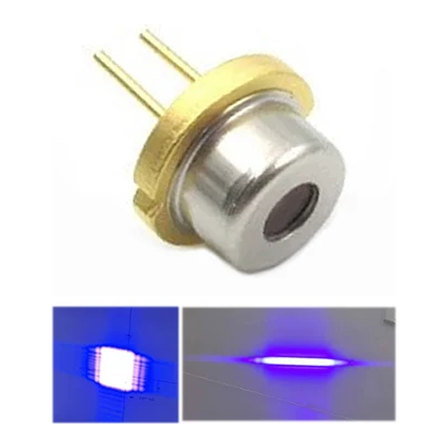 TO9 / LD bank
LZRGB-450-Collimated
450 nm blue visible laser family, CW 5–5.5 W per emitter.
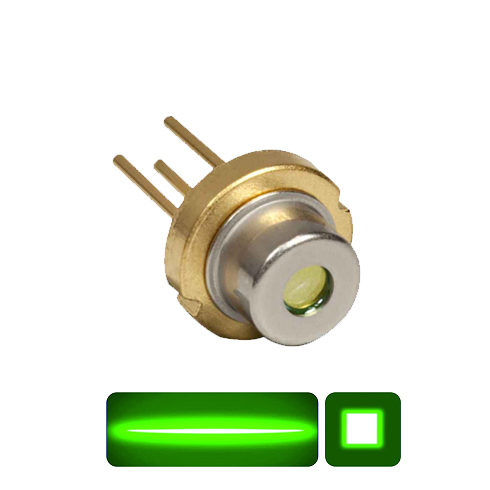 TO9 / TO90 / LD bank
LZRGB-520-Collimated
520 nm green visible laser family, CW 1–1.5 W per emitter with a 13.5 W bank option.
Related reading
905 nm vs 1535 nm vs 1550 nm: choosing a wavelength for ranging and LiDAR
The wavelength decision sets your detector, your eye-safety class, your maximum usable energy and your weather performance. Here is how the three bands actually compare for ranging work.
DetectorsChoosing the receive side: avalanche photodiodes vs PIN photodiodes
Most of a ranging link's margin is recovered at the receiver, not the transmitter. Here is when an APD earns its 10x price, how gain and noise trade off, and what the specification numbers actually mean.
Selection guideHow to choose a 905 nm pulsed laser diode: from range target to part number
A repeatable procedure for turning a range requirement into pulse energy, pulse energy into peak power and pulse width, and peak power into the smallest package that survives your duty cycle.