Selection guide
PLD905-40W-M and PLD905-40W-MCL: 905 nm 40 W pulsed laser diode for long-range ranging
Applications, features and advantages of the PLD905-40W-M and fast-axis collimated PLD905-40W-MCL: 905 nm, 40 W typ., 40 x 18 um emitter, 4-stack structure and TO56 package.
Updated 2026-10-21 · 3 min read
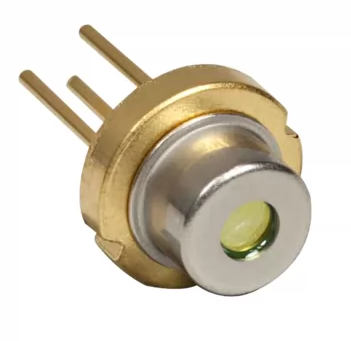
A compact 40 W emitter for long-range pulse ranging
PLD905-40W-M is a 905 nm pulsed laser diode with 40 W typical peak output, a 40 x 18 um emitting area and a four-emitter stack in a TO56 metal package. Its small emitting area provides a practical starting point for collimation and beam shaping in long-range receivers, while short pulses support time-of-flight and single-photon ranging architectures.
PLD905-40W-MCL keeps the same 40 W, 4 uJ and TO56 platform and adds fast-axis collimation. Its perpendicular divergence is reduced from 25 degrees to 6 degrees typical, which can simplify the external optical assembly and reduce the fast-axis capture requirement.
View both catalogue entries: PLD905-40W-M and PLD905-40W-MCL.
Product features and advantages
| Feature | PLD905-40W-M | PLD905-40W-MCL | Engineering value |
|---|---|---|---|
| Peak wavelength | 905 nm, 895 to 915 nm | 905 nm, 895 to 915 nm | Suitable for 905 nm pulse ranging and sensing |
| Peak output | 40 W typ., 37 to 44 W | 40 W typ., 37 to 44 W | More returned pulse energy for a compact emitter |
| Pulse energy at 100 ns | 4 uJ | 4 uJ | Useful for range and receiver budget calculations |
| Emitting area | 40 x 18 um | 40 x 18 um | Compact source for collimation and optical design |
| Emitter structure | 4-stack | 4-stack | Low operating current relative to the optical peak |
| Parallel / perpendicular divergence | 9 / 25 degrees FWHM | 9 / 6 degrees FWHM | MCL reduces fast-axis capture and optical complexity |
| Typical drive condition | 100 ns, 3 kHz, 12 A, 25 C | 100 ns, 3 kHz, 12 A, 25 C | Comparable electrical platform for evaluation |
| Package | TO56 | TO56 | Compact metal package for integrated transmitters |
The standard operating current is about 12 A at 12.6 V typical and the maximum rated pulse width is 100 ns with 0.1 percent duty cycle. Final drive settings must respect the absolute maximum ratings and thermal conditions in the selected datasheet.
Application scenarios
Drone ranging and obstacle avoidance
The 40 W pulse gives the optical and receiver budget room to evaluate terrain ranging, target-distance sensing and obstacle avoidance. System design should consider size, receiver field of view, background-light rejection and aircraft power limits.
Golf flag-lock rangefinders
Flag locking depends on separating the flagpole return from grass, trees and the background. A narrow transmitter beam, controlled receiver field of view and suitable signal processing can improve target selectivity. The laser alone does not guarantee flag discrimination.
Hunting and outdoor long-range ranging
For reflective targets at long distance, the 4 uJ pulse at 100 ns provides a useful link-budget starting point. Performance depends on visibility, target reflectance, aperture, receiver sensitivity and alignment.
SPAD and single-photon LiDAR
Short pulses and a compact source support 1,200 to 3,000 m system design studies for SPAD-based ranging. This range is a system-design direction, not a guaranteed distance for the bare diode. Full validation must include optics, detector timing, filters, target and environmental conditions.
Why choose the MCL version
Without fast-axis optics, the bare emitter has approximately 25 degrees perpendicular divergence. That spread must be captured by the external collimator. PLD905-40W-MCL reduces the perpendicular value to approximately 6 degrees, allowing a more compact or simpler optical train and potentially less sensitive fast-axis alignment.
The MCL version is not automatically a pin-for-pin substitute for every external design. Confirm package drawing, pin option, optical window, driver voltage and allowed operating range before changing the part number.
Safety and design notes
905 nm radiation is invisible and can be hazardous. Complete modules must use appropriate drive protection, thermal design, optical containment and laser-safety measures. IEC 60825-1 classification and end-product testing remain the responsibility of the complete system designer.
Products
Related products
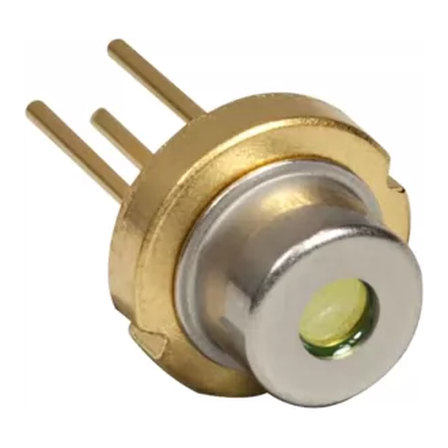 TO56 package
PLD905-40W-M
40 W peak, 905 nm, uncollimated
TO56 package
PLD905-40W-MCL
40 W peak, 905 nm, fast-axis collimated
Calculators
Calculate with this datasheet
Each calculator below opens with this part's datasheet numbers already filled in, in the units the fields ask for.
Transmitter Pulse Parameters
Pulse energy, average power and duty cycle from datasheet peak power, pulse width and repetition rate, for 905 nm PLD and 1535 nm erbium-glass transmitter selection.
Pulse energy 4 μJ · Peak power 40 W · Pulse width 100 ns · Repetition rate 10 kHz · Duty cycle 0.1 % Laser FundamentalsPulse Peak Power
Instantaneous peak power from pulse energy and pulse width.
Peak power 40 W · Pulse energy 0.004 mJ · Pulse width 100 ns Pulses & EnergyDuty Cycle
Ratio of laser on-time to the full period.
Duty cycle 0.1 % · Pulse width 100 ns · Repetition rate 10 kHz · Repetition rate (Hz) 10000 Hz Beam & OpticsSpot Size vs Distance
Beam size at a given distance, from the divergence angle.
Fast-axis divergence (FA) 25 deg · Slow-axis divergence (SA) 9 deg · Fast-axis divergence (FA) 436.332 mrad · Slow-axis divergence (SA) 157.08 mrad · Source fast-axis width 18 μm · Source slow-axis width 40 μm Ranging & LiDARLiDAR Link Budget
Estimate the optical power captured at the receiver.
Related reading
905 nm vs 1535 nm vs 1550 nm: choosing a wavelength for ranging and LiDAR
The wavelength decision sets your detector, your eye-safety class, your maximum usable energy and your weather performance. Here is how the three bands actually compare for ranging work.
DetectorsChoosing the receive side: avalanche photodiodes vs PIN photodiodes
Most of a ranging link's margin is recovered at the receiver, not the transmitter. Here is when an APD earns its 10x price, how gain and noise trade off, and what the specification numbers actually mean.
Selection guideHow to choose a 905 nm pulsed laser diode: from range target to part number
A repeatable procedure for turning a range requirement into pulse energy, pulse energy into peak power and pulse width, and peak power into the smallest package that survives your duty cycle.