












Guide de sélection
PLD905-70W-M vs OSRAM SPL TL90AT03: 70 W and 65 W 905 nm lasers
A datasheet comparison of PLD905-70W-M and OSRAM SPL TL90AT03 covering peak power, voltage, emitter geometry, thermal data, applications and replacement validation.
Mis à jour 2026-11-16 · 3 min de lecture
PLD905-70W-M and OSRAM SPL TL90AT03 are both 905 nm TO56 metal-can lasers aimed at nanosecond pulse applications. The obvious difference is 70 W versus 65 W typical peak power, but voltage, emitter geometry and test conditions decide whether one can replace the other.
Product: PLD905-70W-M.
| Parameter | PLD905-70W-M | SPL TL90AT03 |
|---|---|---|
| Wavelength | 905 nm, 895-915 nm | 905 nm, 898-912 nm |
| Spectral width | 7 nm typical | 7 nm typical |
| Peak power | 70 W, 66-74 W table range | 65 W typical |
| Current | 20 A | 20 A |
| Standard repetition | 3 kHz | 1 kHz |
| Voltage | 15.6 V typical, 14.4-15.8 V | 9.5 V typical |
| Threshold current | 0.75 A typical | 0.3 A typical |
| Emitter | 90 x 18 um | 110 x 10 um |
| Divergence FWHM | 9 x 25 degrees | 10 x 25 degrees |
| Wavelength drift | 0.28 nm/K | Not listed |
| Maximum pulse width / duty | 100 ns / 0.1% | 100 ns / 0.1% |
The 5 W difference is about 7.7% of the 65 W value, but the standard repetition rates differ and the parts use different structures and operating points. It is not a same-condition measurement.
Driver and electrical checks
PLD905-70W-M needs significantly more compliance voltage. Before substitution, verify supply headroom, switch ratings, transformer design, loop inductance and reverse-spike protection. SPL TL90AT03 must also be operated within its own limits rather than the PLD limits.
Measure current, pulse width, edges, overshoot, reverse spikes, repetition, case temperature and sample-to-sample variation on the real board. Use the peak-power, duty-cycle and average-power calculators to check the electrical and thermal operating point.
Optical checks
The 90 x 18 um and 110 x 10 um emitters produce different near-field geometry and different fast/slow-axis collimation requirements. The FWHM divergence is only an input to the optical design, not the target spot size.
Measure the complete far field, collimator NA, alignment tolerance and target-plane spot. The spot-at-distance calculator provides a first footprint estimate.
Application boundaries
PLD905-70W-M can be evaluated for handheld ranging, golf, hunting, construction, UAV sensing and industrial distance measurement. SPL TL90AT03 also lists 3D sensing, gesture recognition, security and machine-control applications.
Neither datasheet makes the bare laser a certified finished product. The OSRAM document states that the component is not released for automotive use or developed as a safety- or medical-grade device. Missing qualification data for the other part must not be read as certification.
Use the LiDAR link-budget calculator when comparing complete ranging architectures.
Replacement sequence
- Confirm PLD905-70W-M suffix, pin option and package drawing.
- Compare driver voltage, current and pulse waveform.
- Measure optical power under identical pulse, repetition, temperature and current.
- Compare near field, far field and target-plane spot.
- Test low- and high-temperature power and wavelength drift.
- Recheck reverse-spike protection and complete-product eye safety.
Conclusion: 70 W versus 65 W is only the starting point. PLD905-70W-M is suitable for evaluation where the driver has enough voltage headroom and the PLD package is appropriate. OSRAM SPL TL90AT03 requires its own lower-voltage, three-emitter thermal design. A same-condition A/B test is mandatory before replacement.
Produits
Produits associés
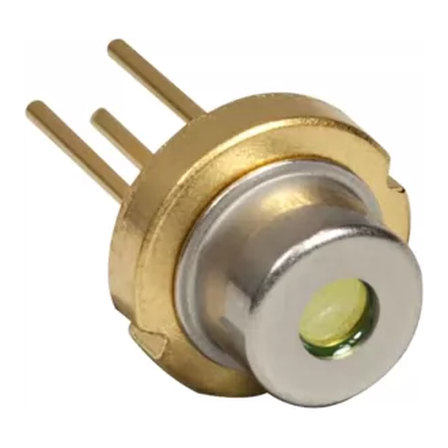 Boîtier TO56
PLD905-70W-M
905 nm, 70 W crête, non collimaté
Calculateurs
Calculer avec cette fiche technique
Chaque calculateur ci-dessous s'ouvre avec les valeurs de la fiche de cette pièce déjà saisies, dans les unités demandées par les champs.
Puissance crête d'impulsion
Puissance crête instantanée à partir de l'énergie et de la largeur d'impulsion.
Puissance crête 70 W · Énergie par impulsion 0.007 mJ · Largeur d'impulsion 100 ns Fondamentaux du laserRapport cyclique et charge thermique
Fraction du temps pendant laquelle le laser est actif, à partir de la largeur d'impulsion et de la fréquence de répétition.
Rapport cyclique 0.1 % · Largeur d'impulsion 100 ns · Fréquence de répétition 10 kHz Fondamentaux du laserPuissance moyenne
Puissance moyenne continue à partir de la fréquence de répétition et de l'énergie par impulsion.
Énergie par impulsion 0.007 mJ · Fréquence de répétition 10 kHz Fondamentaux du laserTaille du spot à la distance z
Rayon du faisceau à une distance z de la taille de mode.
Télémétrie et LiDARBilan de liaison LiDAR
Estime la puissance optique captée au récepteur.
Lectures associées
Laser à fibre homogénéisée multimode 785 nm : illumination uniforme, optique de station totale et limites de validation
Guide pratique d'un laser à fibre homogénéisée 785 nm, 90 mW, 200/340 um, couvrant l'uniformité de l'illumination, l'optique auxiliaire de station totale, le budget de puissance et la mesure.
OptiqueDTS Raman 905 nm : rapport de mise en œuvre et de validation en ingénierie
Un parcours complet en ingénierie à partir d'une pompe pulsée de 905 nm et de canaux Raman d'environ 870/943 nm à travers des APD doubles, acquisition synchrone, correction de perte différentielle, inversion de température, étalonnage et validation du prototype.
Guide de sélection905 nm, 1535 nm ou 1550 nm : choisir une longueur d'onde pour la télémétrie et le LiDAR
Le choix de la longueur d'onde détermine le détecteur, la classe de sécurité oculaire, l'énergie maximale utilisable et le comportement par mauvais temps. Voici comment les trois bandes se comparent réellement pour la télémétrie.