












Auswahlhilfe
PLD905-70W-M vs OSRAM SPL TL90AT03: 70 W and 65 W 905 nm lasers
A datasheet comparison of PLD905-70W-M and OSRAM SPL TL90AT03 covering peak power, voltage, emitter geometry, thermal data, applications and replacement validation.
Aktualisiert 2026-11-16 · 3 Min. Lesezeit
PLD905-70W-M and OSRAM SPL TL90AT03 are both 905 nm TO56 metal-can lasers aimed at nanosecond pulse applications. The obvious difference is 70 W versus 65 W typical peak power, but voltage, emitter geometry and test conditions decide whether one can replace the other.
Product: PLD905-70W-M.
| Parameter | PLD905-70W-M | SPL TL90AT03 |
|---|---|---|
| Wavelength | 905 nm, 895-915 nm | 905 nm, 898-912 nm |
| Spectral width | 7 nm typical | 7 nm typical |
| Peak power | 70 W, 66-74 W table range | 65 W typical |
| Current | 20 A | 20 A |
| Standard repetition | 3 kHz | 1 kHz |
| Voltage | 15.6 V typical, 14.4-15.8 V | 9.5 V typical |
| Threshold current | 0.75 A typical | 0.3 A typical |
| Emitter | 90 x 18 um | 110 x 10 um |
| Divergence FWHM | 9 x 25 degrees | 10 x 25 degrees |
| Wavelength drift | 0.28 nm/K | Not listed |
| Maximum pulse width / duty | 100 ns / 0.1% | 100 ns / 0.1% |
The 5 W difference is about 7.7% of the 65 W value, but the standard repetition rates differ and the parts use different structures and operating points. It is not a same-condition measurement.
Driver and electrical checks
PLD905-70W-M needs significantly more compliance voltage. Before substitution, verify supply headroom, switch ratings, transformer design, loop inductance and reverse-spike protection. SPL TL90AT03 must also be operated within its own limits rather than the PLD limits.
Measure current, pulse width, edges, overshoot, reverse spikes, repetition, case temperature and sample-to-sample variation on the real board. Use the peak-power, duty-cycle and average-power calculators to check the electrical and thermal operating point.
Optical checks
The 90 x 18 um and 110 x 10 um emitters produce different near-field geometry and different fast/slow-axis collimation requirements. The FWHM divergence is only an input to the optical design, not the target spot size.
Measure the complete far field, collimator NA, alignment tolerance and target-plane spot. The spot-at-distance calculator provides a first footprint estimate.
Application boundaries
PLD905-70W-M can be evaluated for handheld ranging, golf, hunting, construction, UAV sensing and industrial distance measurement. SPL TL90AT03 also lists 3D sensing, gesture recognition, security and machine-control applications.
Neither datasheet makes the bare laser a certified finished product. The OSRAM document states that the component is not released for automotive use or developed as a safety- or medical-grade device. Missing qualification data for the other part must not be read as certification.
Use the LiDAR link-budget calculator when comparing complete ranging architectures.
Replacement sequence
- Confirm PLD905-70W-M suffix, pin option and package drawing.
- Compare driver voltage, current and pulse waveform.
- Measure optical power under identical pulse, repetition, temperature and current.
- Compare near field, far field and target-plane spot.
- Test low- and high-temperature power and wavelength drift.
- Recheck reverse-spike protection and complete-product eye safety.
Conclusion: 70 W versus 65 W is only the starting point. PLD905-70W-M is suitable for evaluation where the driver has enough voltage headroom and the PLD package is appropriate. OSRAM SPL TL90AT03 requires its own lower-voltage, three-emitter thermal design. A same-condition A/B test is mandatory before replacement.
Produkte
Verwandte Produkte
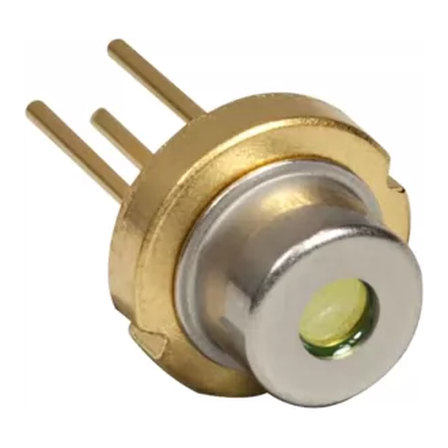 TO56-Gehäuse
PLD905-70W-M
905 nm, 70 W Spitzenleistung, nicht kollimiert
Rechner
Mit diesem Datenblatt rechnen
Jeder Rechner unten öffnet sich mit den Datenblattwerten dieses Bauteils bereits eingetragen, in den Einheiten, die die Felder verlangen.
Puls-Spitzenleistung
Momentane Spitzenleistung aus Pulsenergie und Pulsbreite.
Spitzenleistung 70 W · Pulsenergie 0.007 mJ · Pulsbreite 100 ns Laser-GrundlagenTastgrad und thermische Last
Anteil der Einschaltzeit des Lasers aus Pulsbreite und Wiederholrate.
Tastgrad 0.1 % · Pulsbreite 100 ns · Wiederholrate 10 kHz Laser-GrundlagenMittlere Leistung
Kontinuierliche mittlere Leistung aus Wiederholrate und Energie pro Puls.
Energie pro Puls 0.007 mJ · Wiederholrate 10 kHz Laser-GrundlagenFleckgröße bei Entfernung z
Strahlradius in einer Entfernung z von der Taille.
Entfernungsmessung & LiDARLiDAR-Linkbudget
Abschätzung der am Empfänger erfassten optischen Leistung.
Weiterführende Lektüre
785-nm-Multimode-homogenisierter-Faserlaser: gleichmäßige Beleuchtung, Totalstation-Optik und Validierungsgrenzen
Ein praktischer Leitfaden für einen 785-nm-, 90-mW-, 200/340-µm-homogenisierten-Faserlaser, der die Gleichmäßigkeit der Beleuchtung, Zusatzoptik für Totalstationen, Leistungsbudgetierung und Messung abdeckt.
Optik905 nm Raman DTS: Bericht über Ingenieurumsetzung und Validierung
Eine vollständige Ingenieurstrecke von einer 905 nm gepulsten Pumpe und etwa 870/943 nm Raman-Kanälen über duale APDs, synchrone Erfassung, Differenzverlusterkennung, Temperaturinversion, Kalibrierung und Prototypenvalidierung.
Auswahlhilfe905 nm, 1535 nm oder 1550 nm: die Wellenlänge für Entfernungsmessung und LiDAR wählen
Die Wahl der Wellenlänge bestimmt Detektor, Laserschutzklasse, nutzbare Energie und Wetterverhalten. So schneiden die drei Bänder bei der Entfernungsmessung tatsächlich ab.