












Guía de selección
PLD905-70W-M vs OSRAM SPL TL90AT03: 70 W and 65 W 905 nm lasers
A datasheet comparison of PLD905-70W-M and OSRAM SPL TL90AT03 covering peak power, voltage, emitter geometry, thermal data, applications and replacement validation.
Actualizado 2026-11-16 · 3 min de lectura
PLD905-70W-M and OSRAM SPL TL90AT03 are both 905 nm TO56 metal-can lasers aimed at nanosecond pulse applications. The obvious difference is 70 W versus 65 W typical peak power, but voltage, emitter geometry and test conditions decide whether one can replace the other.
Product: PLD905-70W-M.
| Parameter | PLD905-70W-M | SPL TL90AT03 |
|---|---|---|
| Wavelength | 905 nm, 895-915 nm | 905 nm, 898-912 nm |
| Spectral width | 7 nm typical | 7 nm typical |
| Peak power | 70 W, 66-74 W table range | 65 W typical |
| Current | 20 A | 20 A |
| Standard repetition | 3 kHz | 1 kHz |
| Voltage | 15.6 V typical, 14.4-15.8 V | 9.5 V typical |
| Threshold current | 0.75 A typical | 0.3 A typical |
| Emitter | 90 x 18 um | 110 x 10 um |
| Divergence FWHM | 9 x 25 degrees | 10 x 25 degrees |
| Wavelength drift | 0.28 nm/K | Not listed |
| Maximum pulse width / duty | 100 ns / 0.1% | 100 ns / 0.1% |
The 5 W difference is about 7.7% of the 65 W value, but the standard repetition rates differ and the parts use different structures and operating points. It is not a same-condition measurement.
Driver and electrical checks
PLD905-70W-M needs significantly more compliance voltage. Before substitution, verify supply headroom, switch ratings, transformer design, loop inductance and reverse-spike protection. SPL TL90AT03 must also be operated within its own limits rather than the PLD limits.
Measure current, pulse width, edges, overshoot, reverse spikes, repetition, case temperature and sample-to-sample variation on the real board. Use the peak-power, duty-cycle and average-power calculators to check the electrical and thermal operating point.
Optical checks
The 90 x 18 um and 110 x 10 um emitters produce different near-field geometry and different fast/slow-axis collimation requirements. The FWHM divergence is only an input to the optical design, not the target spot size.
Measure the complete far field, collimator NA, alignment tolerance and target-plane spot. The spot-at-distance calculator provides a first footprint estimate.
Application boundaries
PLD905-70W-M can be evaluated for handheld ranging, golf, hunting, construction, UAV sensing and industrial distance measurement. SPL TL90AT03 also lists 3D sensing, gesture recognition, security and machine-control applications.
Neither datasheet makes the bare laser a certified finished product. The OSRAM document states that the component is not released for automotive use or developed as a safety- or medical-grade device. Missing qualification data for the other part must not be read as certification.
Use the LiDAR link-budget calculator when comparing complete ranging architectures.
Replacement sequence
- Confirm PLD905-70W-M suffix, pin option and package drawing.
- Compare driver voltage, current and pulse waveform.
- Measure optical power under identical pulse, repetition, temperature and current.
- Compare near field, far field and target-plane spot.
- Test low- and high-temperature power and wavelength drift.
- Recheck reverse-spike protection and complete-product eye safety.
Conclusion: 70 W versus 65 W is only the starting point. PLD905-70W-M is suitable for evaluation where the driver has enough voltage headroom and the PLD package is appropriate. OSRAM SPL TL90AT03 requires its own lower-voltage, three-emitter thermal design. A same-condition A/B test is mandatory before replacement.
Productos
Productos relacionados
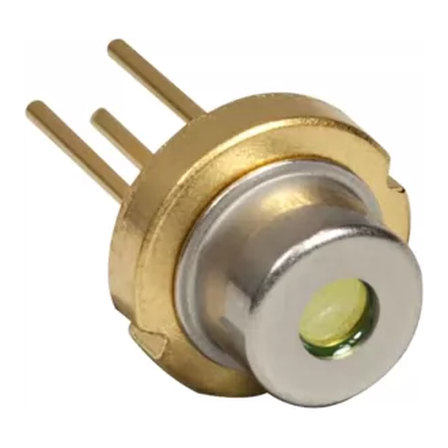 Encapsulado TO56
PLD905-70W-M
70 W pico, 905 nm, sin colimar
Calculadoras
Calcular con esta hoja de datos
Cada calculadora de abajo se abre con los valores de la ficha de esta pieza ya rellenados, en las unidades que piden los campos.
Potencia pico de pulso
Potencia pico instantánea a partir de la energía y la anchura del pulso.
Potencia pico 70 W · Energía de pulso 0.007 mJ · Anchura de pulso 100 ns Fundamentos del láserCiclo de trabajo y carga térmica
Fracción de tiempo que el láser está encendido, a partir de la anchura de pulso y la frecuencia de repetición.
Ciclo de trabajo 0.1 % · Anchura de pulso 100 ns · Frecuencia de repetición 10 kHz Fundamentos del láserPotencia media
Potencia media continua a partir de la frecuencia de repetición y la energía por pulso.
Energía por pulso 0.007 mJ · Frecuencia de repetición 10 kHz Fundamentos del láserTamaño de punto a distancia z
Radio del haz a una distancia z desde la cintura.
Medición y LiDARPresupuesto de enlace LiDAR
Estima la potencia óptica captada en el receptor.
Lecturas relacionadas
Láser de fibra homogeneizada multimodo de 785 nm: iluminación uniforme, óptica de estación total y límites de validación
Guía práctica de un láser de fibra homogeneizada de 785 nm, 90 mW, 200/340 um, que abarca uniformidad de iluminación, óptica auxiliar de estación total, presupuesto de potencia y medición.
Óptica905 nm Raman DTS: informe de implementación y validación de ingeniería
Una ruta completa de ingeniería desde una bomba pulsada de 905 nm y aproximadamente canales Raman de 870/943 nm a través de APD duales, adquisición síncrona, corrección de pérdida diferencial, inversión de temperatura, calibración y validación de prototipo.
Guía de selección905 nm frente a 1535 nm frente a 1550 nm: elegir una longitud de onda para medición de distancia y LiDAR
La decisión de longitud de onda fija tu detector, tu clase de seguridad ocular, tu energía máxima utilizable y tu rendimiento con mal tiempo. Así se comparan realmente las tres bandas para aplicaciones de medición.