












Selection guide
PLD905-25W-M vs ROHM RLD90QZW5: choosing a 25 W class 905 nm pulsed laser
A datasheet-based comparison of PLD905-25W-M and ROHM RLD90QZW5, covering peak power, pulse conditions, drive, divergence, packaging, application fit and same-condition qualification.
Updated 2026-11-24 · 6 min read
PLD905-25W-M and ROHM RLD90QZW5 are both aimed at 905 nm pulsed ranging, time-of-flight sensing and short-to-medium-range LiDAR. Both sit in the "25 W class", but their datasheets use different pulse widths, drive currents, voltages and test conditions. A single peak-power number is therefore not a fair comparison.
The first step is to separate typical values, limits and test conditions. This article follows the supplied PLD905-25W-M V3.0 datasheet and ROHM RLD90QZW5 datasheet, 2020.9 Rev.001. Final selection requires the current controlled datasheet and same-condition measurements.
Main conclusion: PLD905-25W-M has a 29 W typical value at 100 ns, 11 A, 3 kHz and 25 °C. ROHM RLD90QZW5 has a 25 W typical value at 9 A with a stated 50 ns operating condition. Neither number should be used as a direct same-condition comparison or as a system range guarantee.
| Parameter | PLD905-25W-M | ROHM RLD90QZW5 | Engineering consequence |
|---|---|---|---|
| Centre wavelength | 905 nm, 895-915 nm | 905 nm, 895-915 nm | Both are invisible near-infrared pulsed sources; wavelength shifts with junction temperature |
| Peak optical power | 23.9 W min, 29 W typ, 32.8 W max; 25 W class ordering | 25 W typ at 9 A | Different pulse and current conditions; remeasure in the target system |
| Pulse width | Standard point 100 ns; short-pulse range 1-100 ns | 50 ns operating condition; 50 ns maximum rating table | Match pulse width to energy, receiver bandwidth and timing resolution |
| Drive current | 9 A min, 11 A typ, 13 A max | 9 A | PLD uses higher typical current; ROHM reaches its rated output at a lower current |
| Operating voltage | 8.8-10 V, 9.4 V typ | 14 V typ, 20 V max at 9 A | Current and voltage must be designed together |
| Threshold current | 0.5-1 A, 0.75 A typ | 0.4 A typ, 1.0 A max | Threshold is not an operating point and does not by itself define efficiency |
| Divergence FWHM | 9° / 25° typ; 10° / 28° max | 12° / 25° typ; 5-19° / 17-33° range | PLD has a narrower typical parallel-PN angle; vertical typical values match |
| Emitter | 70 x 10 um | 70 x 10 um | Equal emitter geometry does not guarantee equal system far-field spot |
| Spectral width | 7 nm FWHM typ | Not listed in the supplied parameter table | Request batch spectra when filter bandwidth or drift matters |
| Wavelength temperature coefficient | 0.28 nm/K typ | Not listed in the supplied parameter table | Check filter passband over the full operating temperature |
| Beam-angle tolerance | No equivalent number in supplied table | ±5° | ROHM data directly supports optomechanical tolerance analysis |
| Emitter-position tolerance | No equivalent number in supplied table | ±150 um | Useful for datum design and automated coupling |
| Duty cycle | 0.1% absolute maximum | 0.1% absolute maximum; 0.05% stated operating condition | Pulse width and repetition rate must satisfy thermal limits together |
| Operating temperature | -40 to +85 °C | -40 to +85 °C case temperature | Monitor actual package temperature, not only ambient |
| Storage temperature | -40 to +100 °C | -40 to +85 °C | Use the current supplier datasheet |
| Reverse voltage | 20 V absolute maximum | 2 V absolute maximum | Never use an absolute limit as a normal operating condition |
| Package | TO56 metal, multiple pin and pitch variants | 5.6 mm metal can, three pins | Similar outline does not make the parts drop-in compatible |
Beam and optics
Both devices specify a 70 x 10 um emitter. The PLD905-25W-M parallel-PN typical divergence is 9° versus 12° for RLD90QZW5; both list 25° in the perpendicular direction. These are bare-device far-field FWHM values, not the divergence after a collimator.
After collimation, spot size depends on lens NA, focal length, working distance, emitter position relative to the mechanical datum, protective windows and assembly tolerances. ROHM supplies ±5° beam-angle tolerance and ±150 um emitter-position tolerance for the tolerance budget. The PLD's narrower typical slow-axis divergence may help systems sensitive to that direction.
The statistical and limit definitions are not identical, so neither part can be called categorically more consistent without measurements. Qualify FWHM in both orthogonal directions, collimated divergence, spot ellipticity and energy distribution at the working distance.
Drive conditions
The PLD905-25W-M standard point is 11 A, 9.4 V, 100 ns, 3 kHz and 25 °C. This suits a design built around an approximately 100 ns pulse window, but the high-current loop must remain short and low inductance, with current clamping, overshoot protection and the correct pin variant.
ROHM RLD90QZW5 reaches its 25 W typical output at 9 A, with 14 V typical, 20 V maximum and a 50 ns operating condition. The datasheet recommends a heat spreader of at least 30 x 30 x 3 mm aluminium or equivalent on the metal stem. Its 2 V reverse-voltage limit makes reverse connection, supply transients and switching spikes especially important.
Do not size the driver from average power alone. Check peak current, rise time, pulse width, repetition rate, duty cycle, loop inductance, capacitor ESL, overshoot and junction temperature. Use the peak-power calculator and duty-cycle calculator, then review nanosecond pulse-driver design.
Application fit
| Application | PLD905-25W-M | ROHM RLD90QZW5 |
|---|---|---|
| Handheld rangefinder / golf flag lock | Evaluate around the 100 ns standard condition and higher typical peak power | Evaluate the 50 ns condition and the specified angle and emitter-position tolerances |
| Drone ranging and obstacle avoidance | Listed as a product application direction | TOF sensor is a listed datasheet application |
| TOF sensor / short and medium LiDAR | Test the longer-pulse, higher-peak-power route | Test the shorter 50 ns timing route |
| Volume module / automated optics | Multiple pin and pitch variants; freeze the full ordering suffix before production | ±150 um emitter tolerance and ±5° angle tolerance support assembly analysis |
These are engineering fit assessments from the datasheets, not measured system promises.
Selection guidance
Evaluate PLD905-25W-M first when the timing plan uses approximately 100 ns pulses, the parallel-PN divergence matters, a particular TO56 pin variant is required, or the application is close to handheld ranging and drone obstacle avoidance.
Evaluate ROHM RLD90QZW5 first when the TOF architecture is designed around 50 ns pulses, the optomechanical budget can use the ±5° angle and ±150 um position tolerances, and the driver can support approximately 9 A at 14 V with sufficient transient and thermal margin.
Five same-condition checks before release
- Measure peak power and pulse energy at the same case temperature, pulse width, repetition rate and drive current.
- Measure FWHM in both orthogonal directions, collimated divergence, spot ellipticity and energy distribution.
- Record case temperature, wavelength drift, output decay and thermal equilibrium in the final enclosure.
- Inspect rise time, overshoot, reverse spikes, ESD and power-cycle transients; add temperature cycling and life sampling.
- Verify pinout, footprint, package dimensions, emitter position, collimator datum, batch spread and the complete ordering code.
905 nm is invisible infrared radiation. Classify and protect the complete product against the applicable laser-safety standard. Never view the emitting window directly or through a lens.
Source document
Download the original Chinese comparison page. The original conclusion, parameter table, application analysis, qualification list and safety note are preserved; decorative diagrams from the standalone page are not reproduced.
Products
Related products
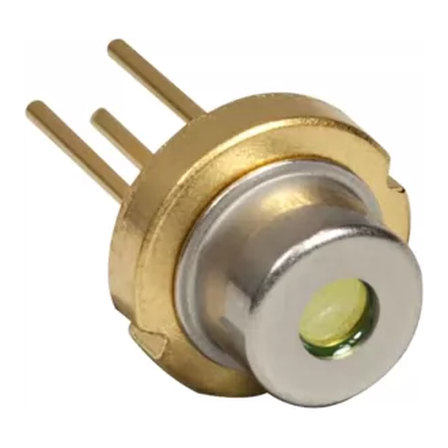 TO56 package
PLD905-25W-M
25 W peak, 905 nm, uncollimated
Calculators
Calculate with this datasheet
Each calculator below opens with this part's datasheet numbers already filled in, in the units the fields ask for.
Pulse Peak Power
Instantaneous peak power from pulse energy and pulse width.
Peak power 25 W · Pulse energy 0.0025 mJ · Pulse width 100 ns Laser FundamentalsAverage Power
Continuous average power from repetition rate and energy per pulse.
Energy per pulse 0.0025 mJ · Repetition rate 10 kHz Pulses & EnergyDuty Cycle
Ratio of laser on-time to the full period.
Duty cycle 0.1 % · Pulse width 100 ns · Repetition rate 10 kHz · Repetition rate (Hz) 10000 Hz Ranging & LiDARLiDAR Far-Field Spot
Beam diameter at long range.
Ranging & LiDARLiDAR Link Budget
Estimate the optical power captured at the receiver.
Related reading
785 nm multimode homogenized-fiber laser: uniform illumination, total-station optics and validation limits
A practical guide to a 785 nm, 90 mW, 200/340 um homogenized-fiber laser, covering illumination uniformity, total-station auxiliary optics, power budgeting and measurement.
Optics905 nm Raman DTS: engineering implementation and validation report
A complete engineering route from a 905 nm pulsed pump and approximately 870/943 nm Raman channels through dual APDs, synchronous acquisition, differential-loss correction, temperature inversion, calibration and prototype validation.
Selection guide905 nm vs 1535 nm vs 1550 nm: choosing a wavelength for ranging and LiDAR
The wavelength decision sets your detector, your eye-safety class, your maximum usable energy and your weather performance. Here is how the three bands actually compare for ranging work.