Golf rangefinder teardown
Anatomy of a golf laser rangefinder
A golf rangefinder is the four subsystems the other ranging products carry - the emitter, the detector, the optics between them and the electronics that time the round trip - plus a fifth one they do not have: the tilt sensor and the display that turn a distance into a number the player can hit. Pick a part from the bill of materials and drop it on the unit; every parameter comes with the catalogue parts that carry it.
- 1Wählen Sie ein Teil aus der Stückliste.
- 2Ziehen Sie es auf das Modul oder klicken Sie einfach die Karte an.
- 3Lesen Sie seine Aufgabe, seine Parameter und die Bestellnummern dahinter.
Stückliste
Jedes Teil, ein optisches Budget. Ziehen Sie eine Karte auf das Foto oder klicken Sie sie an - das Feld daneben füllt sich mit den Parametern dieses Teils.
Teil hierher ziehen oder eine Karte in der Stückliste anklicken
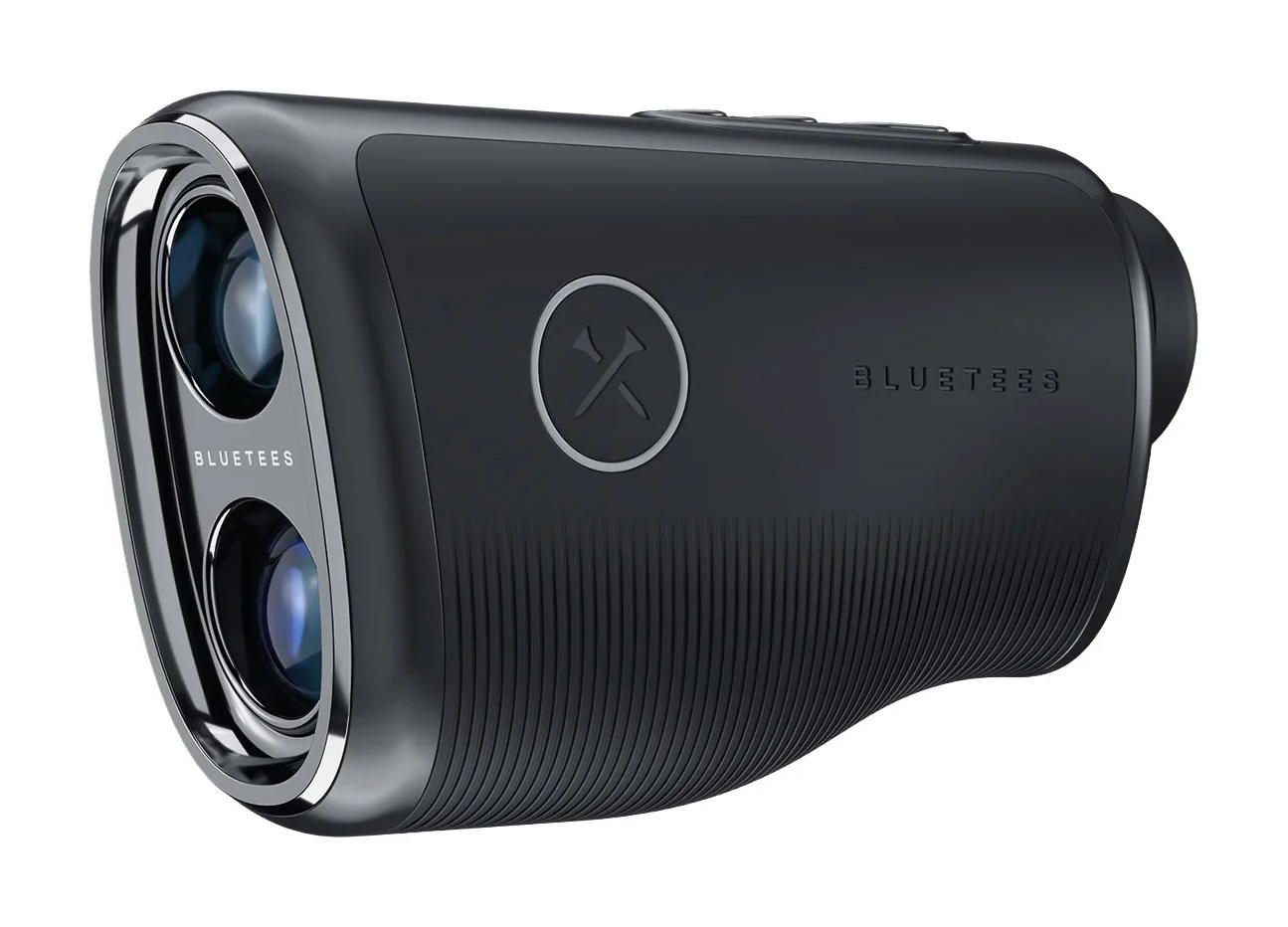
A handheld golf rangefinder, three-quarter view. The two apertures at the front left are the transmit and receive windows, the ocular is at the right, and the control ridge runs along the top.
Die Positionen der Komponenten sind ein Lehrschema, keine Montagezeichnung: Anordnung und Explosionsdarstellung sind Richtwerte. Parameterwerte sind die der verlinkten Spezifikation.
Jedes Teil, Parameter für Parameter
Dieselben Zahlen wie in der interaktiven Ansicht, in Tabellen, die Sie lesen, durchsuchen und zitieren können.
905 nm laser diode Transmitter
Emits the ranging pulse. On a golf unit peak power, pulse width and divergence are chosen for a few hundred metres and for thousands of measurements on one battery, so the compact end of the family is where the design starts - not the highest peak power on the list.
| Peak wavelength | 905 nm (895 - 915 nm) |
|---|---|
| Peak output power | 15 - 600 W |
| Pulse energy @ 100 ns | 1.5 - 30 uJ |
| Beam divergence, FWHM | 9 x 25 deg bare | 9 x 6 deg FAC |
| Pulse width | 1 - 100 ns (max 100 ns) |
| Duty cycle, max | 0.1 % |
| Repetition rate | up to 10 kHz |
| Package | TO56 | bare die | VCSEL array |
| Est. range, retro-reflective (40 W) | 755 m |
| Est. range, diffuse target (40 W) | 250 m |
Avalanche photodiode Receiver
Sets how weak a return the product can still trust. On a short-range unit the small-area packages are the right choice: less dark current and less capacitance than a large area, which is what keeps the timing edge sharp.
| Response spectrum | 400 - 1100 nm |
|---|---|
| Wavelength | 905 nm |
| Active area | 230 um TO-46 | 500 um LCC ceramic |
| Responsivity | 80 A/W @ M=100 |
| Response time | 0.5 ns |
| Dark current | 0.4 nA @ M=100 |
| Total capacitance | 1.0 pF @ M=100 |
| Optimum gain | 100 |
| Reverse breakdown voltage | 100 - 200 V |
| Optical filter | 905 nm spike filter |
| Package | TO-46 | LCC1 / LCC2 ceramic |
Emit / receive optics Optical path
Splits the light: the transmit aperture has to get the pulse out inside the receive aperture's field of view, and the receive aperture has to collect enough of the return without also collecting the transmitter's own glare.
| Optical channels | 2 ranging (transmit + receive) + observation path |
|---|---|
| Windows on the front face | 2 |
| Transmit beam, bare | 25 deg |
| Transmit beam, FAC | 6 deg |
| Receive aperture / focal length | Set by your optical design Von Ihrem Entwurf festgelegt |
| Transmission | To be confirmed against the drawing and a test band Von Ihrem Entwurf festgelegt |
| Receive filtering | 905 nm spike filter at the detector |
Drive and timing Electronics
Turns a stored capacitor into a nanosecond current pulse and turns the detector's edge back into a number. On a golf unit it also has to hold calibration across temperature, because the whole product is judged on repeatability.
| Peak pulse current | 70 A |
|---|---|
| Pulse width | 50 ns - 1 us adjustable |
| Repetition rate | 1 kHz - 30 kHz adjustable |
| Rise time | 7.5 ns typical |
| Fall time | 12 ns typical |
| Supply voltage | 12 V DC |
| Laser drive voltage | 1 - 50 V DC |
| Control interface | Internal trigger / external TTL |
| Factory default | 100 ns @ 3 kHz, internal trigger |
| Detector bias | 100 - 200 V reverse, temperature compensated Von Ihrem Entwurf festgelegt |
Tilt and display Interface
Adds the two things a plain rangefinder does not have - an angle, and a readable number. Which of the straight-line distance, the angle and a compensated distance the unit shows is a product decision, and a regulated one in some competitions.
| Tilt measurement range | To be confirmed: product specification Von Ihrem Entwurf festgelegt |
|---|---|
| Angle accuracy / resolution | To be confirmed: specification and calibration conditions Von Ihrem Entwurf festgelegt |
| Slope compensation | To be confirmed: whether this model supports it and how it is switched Von Ihrem Entwurf festgelegt |
| Display type / readout | To be confirmed: LCD, OLED or a projected reticle Von Ihrem Entwurf festgelegt |
| Buttons and modes | To be confirmed: product definition Von Ihrem Entwurf festgelegt |
| Indicator channel | Optional visible laser - see the parts below |
Jeder Parameterwert auf dieser Seite stammt aus dem Katalogeintrag, der die verlinkte Produktseite erzeugt, sodass die beiden nicht widersprechen können.
Bauteile hinter diesen Parametern
Jede Zahl unten kommt aus demselben Katalogeintrag, der die Produktseite erzeugt. Hier ist nichts neu abgetippt.
Handheld 905 nm transmit chain
A flag is a cooperative target a few hundred metres away, so the design starts at the bottom of the power range and spends the budget on repetition rate and battery life instead.
What the emitter is built from
Two ways to build the transmit source for a sealed handheld: take the bare stacked die and package it yourself, or take a VCSEL array that is already low-profile and rugged.
Receive chain
Short range means a small active area is not a compromise - it is the better choice: less dark current, less capacitance, a sharper timing edge.
Drive and timing
One board with the pulse generator and the driver on it, at a repetition rate a golf unit can actually use.
Indicator and aiming optics
For a unit that adds a visible aiming dot or an illuminated indicator next to the invisible ranging path.
This unit is the 905 nm / pulsed / short-range scenario
Run the selector with application = rangefinder, wavelength = 905 nm and output = pulsed, then keep the peak power low: a flag is a cooperative target a few hundred metres away, so the transmit chain below is taken from the compact end of the family. The catalogue carries the same four subsystems up to 1.6 km and 2.1 km if the product has to grow, and an eye-safe 1535 nm chain if it has to.
Tell us the range, the target and the size limit
A golf rangefinder is the tightest package in the ranging family: one battery, a few hundred metres and a number on a screen. Send us the range you need and the space you have, and we come back with the transmit chain, the receiver and the optics between them.