












Seçim kılavuzu
TO38 compact 905 nm pulsed laser for AI glasses and golf rangefinding
A compact TO38 905 nm transmitter guide for lightweight AI glasses and golf rangefinders, covering 40 W/70 W configuration directions, FAC optics, pulse drive, mechanics and eye-safety validation.
Güncellendi 2026-11-16 · 3 dk okuma
When ranging moves into AI glasses, wearables and compact spatial-sensing devices, the laser is no longer selected by peak power alone. Package height, pin layout, emitter position, collimation space and heat path all affect whether the product can fit.
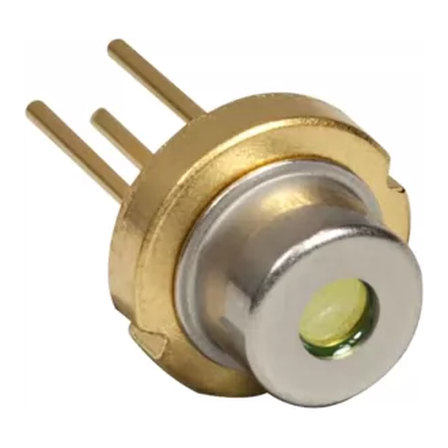
The TO38 direction provides a smaller TO metal package for a 905 nm pulsed transmitter. The closest catalogue platforms are PLD905-40W-MCL and PLD905-70W-M. The exact TO38 suffix, pin option and optical window must be confirmed against the controlled datasheet.
Why use a compact TO38 transmitter?
- More room in a glasses temple, frame or miniature ranging module.
- A shorter optical axis for transmitter, collimation and receiver integration.
- FAC compression to reduce the external fast-axis capture requirement.
- A small emitter as a starting point for a narrow transmitter beam.
- A practical component route for short-to-medium-range active sensing.
A smaller package does not automatically increase complete-system range. Pulse energy, divergence, receiver aperture, detector sensitivity and signal processing still set detection performance.
Typical 40 W platform
| Parameter | Typical value | Engineering meaning |
|---|---|---|
| Peak wavelength | 905 nm | Matches common silicon APD/SPAD receivers |
| Spectral width | 7 nm FWHM | Used in filter and thermal-drift budgets |
| Peak optical power | 40 W | 37-44 W listed range |
| Threshold current | 0.75 A | Low-current behaviour still needs validation |
| Operating current | 12 A | Standard condition: 100 ns, 3 kHz, 25 C |
| Operating voltage | 12.6 V | Driver compliance must cover pulse overshoot |
| Emitter | 40 x 18 um | Not the target-plane spot size |
| Slow-axis divergence | 9 degrees FWHM | Used with the external collimator |
| Fast-axis divergence | 6 degrees FWHM | Reduced capture requirement with FAC/MCL |
| Maximum pulse width | 100 ns | Intended for short-pulse operation |
| Maximum duty cycle | 0.1% | Pulse width, repetition and temperature must be combined |
Use the peak-power calculator, duty-cycle calculator and spot-at-distance calculator to check the operating point.
AI glasses
AI glasses use active ranging for object distance, interaction and obstacle feedback. A TO38 transmitter may fit inside a temple or frame, but the design should also verify:
- Optical-axis alignment against cameras, IMUs and displays.
- Accessible laser exposure during normal wearing conditions.
- Pulse energy and receiver SNR at low average power.
- Frame thermal paths and surface temperature.
- Drop, sweat, humidity and vibration reliability.
For short-range high-repetition operation, build the optical link budget rather than increasing peak power blindly. The LiDAR link-budget calculator is a useful starting point.
Golf rangefinding
Golf flag locking depends on separating the flagpole from trees, grass and background terrain. A narrow transmitter beam, controlled receiver field of view and target-selection algorithm work together. TO38 and FAC optics can support a compact transmitter path, but the final spot is set by the complete optical assembly.
Check target-plane spot size, receiver field of view, response time, background rejection, temperature drift and complete-product eye safety. The far-field LiDAR spot calculator helps estimate the collimated beam footprint.
Integration checklist
- Verify package drawing, pin polarity, window direction and optical datum.
- Measure pulse current, voltage, edges, width and overshoot on the real driver.
- Measure source and target-plane spots, not just divergence angles.
- Test wavelength and power drift across the operating temperature range.
- Validate the frame or product for heat, vibration, drop and long-run stability.
- Classify the complete product using its actual pulse energy, repetition and optics.
Products: PLD905-40W-MCL and PLD905-70W-M. The final TO38 configuration must follow the ordered datasheet and sample drawing.
Ürünler
İlgili ürünler
 TO56 kılıf
PLD905-40W-MCL
905 nm, 40 W tepe, hızlı eksen kolimasyonlu
TO56 kılıf
PLD905-70W-M
905 nm, 70 W tepe, kolimasyonsuz
Hesaplayıcılar
Bu veri sayfasıyla hesaplayın
Aşağıdaki her hesaplayıcı, bu parçanın veri sayfası değerleri alanların istediği birimlerde önceden doldurulmuş olarak açılır.
Darbe Tepe Gücü
Mühendislik hesaplayıcısı: darbe tepe gücü hesaplar ve girdilerin sonuç üzerindeki etkisini değerlendirir.
Tepe güç 40 W · Darbe enerjisi 0.004 mJ · Darbe genişliği 100 ns Lazer TemelleriGörev Döngüsü ve Isıl Yük
Mühendislik hesaplayıcısı: görev döngüsü ve isıl yük hesaplar ve girdilerin sonuç üzerindeki etkisini değerlendirir.
Görev döngüsü 0.1 % · Darbe genişliği 100 ns · Tekrar hızı 10 kHz Lazer Temelleriz Mesafesindeki Nokta Boyutu
Mühendislik hesaplayıcısı: z mesafesindeki nokta boyutu hesaplar ve girdilerin sonuç üzerindeki etkisini değerlendirir.
Mesafe Ölçümü ve LiDARLiDAR Uzak Alan Noktası
Mühendislik hesaplayıcısı: lidar uzak alan noktası hesaplar ve girdilerin sonuç üzerindeki etkisini değerlendirir.
Mesafe Ölçümü ve LiDARLiDAR Bağlantı Bütçesi
Mühendislik hesaplayıcısı: lidar bağlantı bütçesi hesaplar ve girdilerin sonuç üzerindeki etkisini değerlendirir.
İlgili okumalar
785 nm multimod homogenize-fiber lazer: uniform aydınlatma, total-station optiği ve doğrulama limitleri
Aydınlatma uniformluğunu, total-station yardımcı optiğini, güç bütçelemesini ve ölçümü kapsayan 785 nm, 90 mW, 200/340 um homogenize-fiber lazere pratik bir rehber.
Optik905 nm Raman DTS: mühendislik uygulama ve doğrulama raporu
905 nm darbeli pompa ve yaklaşık 870/943 nm Raman kanalları üzerinden çift APD, eşzamanlı edinim, diferansiyel kayıp düzeltmesi, sıcaklık ters çevirme, kalibrasyon ve prototip doğrulaması içeren eksiksiz bir mühendislik yolu.
Seçim kılavuzu905 nm, 1535 nm ve 1550 nm: mesafe ölçümü ve LiDAR için dalga boyu seçimi
Dalga boyu kararı dedektörünüzü, göz güvenliği sınıfınızı, kullanabileceğiniz en yüksek enerjiyi ve hava koşullarındaki performansınızı belirler. Üç bandın mesafe ölçümünde gerçekte nasıl karşılaştığını açıklıyoruz.