












選定ガイド
TO38 compact 905 nm pulsed laser for AI glasses and golf rangefinding
A compact TO38 905 nm transmitter guide for lightweight AI glasses and golf rangefinders, covering 40 W/70 W configuration directions, FAC optics, pulse drive, mechanics and eye-safety validation.
更新 2026-11-16 · 3 分で読めます
When ranging moves into AI glasses, wearables and compact spatial-sensing devices, the laser is no longer selected by peak power alone. Package height, pin layout, emitter position, collimation space and heat path all affect whether the product can fit.
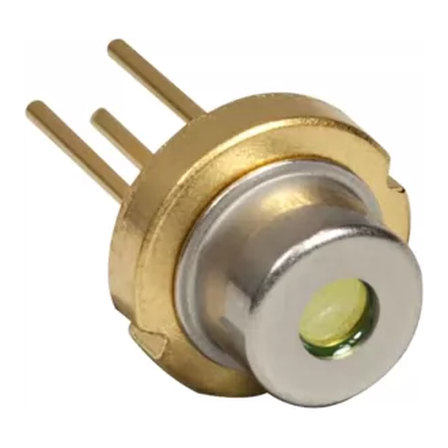
The TO38 direction provides a smaller TO metal package for a 905 nm pulsed transmitter. The closest catalogue platforms are PLD905-40W-MCL and PLD905-70W-M. The exact TO38 suffix, pin option and optical window must be confirmed against the controlled datasheet.
Why use a compact TO38 transmitter?
- More room in a glasses temple, frame or miniature ranging module.
- A shorter optical axis for transmitter, collimation and receiver integration.
- FAC compression to reduce the external fast-axis capture requirement.
- A small emitter as a starting point for a narrow transmitter beam.
- A practical component route for short-to-medium-range active sensing.
A smaller package does not automatically increase complete-system range. Pulse energy, divergence, receiver aperture, detector sensitivity and signal processing still set detection performance.
Typical 40 W platform
| Parameter | Typical value | Engineering meaning |
|---|---|---|
| Peak wavelength | 905 nm | Matches common silicon APD/SPAD receivers |
| Spectral width | 7 nm FWHM | Used in filter and thermal-drift budgets |
| Peak optical power | 40 W | 37-44 W listed range |
| Threshold current | 0.75 A | Low-current behaviour still needs validation |
| Operating current | 12 A | Standard condition: 100 ns, 3 kHz, 25 C |
| Operating voltage | 12.6 V | Driver compliance must cover pulse overshoot |
| Emitter | 40 x 18 um | Not the target-plane spot size |
| Slow-axis divergence | 9 degrees FWHM | Used with the external collimator |
| Fast-axis divergence | 6 degrees FWHM | Reduced capture requirement with FAC/MCL |
| Maximum pulse width | 100 ns | Intended for short-pulse operation |
| Maximum duty cycle | 0.1% | Pulse width, repetition and temperature must be combined |
Use the peak-power calculator, duty-cycle calculator and spot-at-distance calculator to check the operating point.
AI glasses
AI glasses use active ranging for object distance, interaction and obstacle feedback. A TO38 transmitter may fit inside a temple or frame, but the design should also verify:
- Optical-axis alignment against cameras, IMUs and displays.
- Accessible laser exposure during normal wearing conditions.
- Pulse energy and receiver SNR at low average power.
- Frame thermal paths and surface temperature.
- Drop, sweat, humidity and vibration reliability.
For short-range high-repetition operation, build the optical link budget rather than increasing peak power blindly. The LiDAR link-budget calculator is a useful starting point.
Golf rangefinding
Golf flag locking depends on separating the flagpole from trees, grass and background terrain. A narrow transmitter beam, controlled receiver field of view and target-selection algorithm work together. TO38 and FAC optics can support a compact transmitter path, but the final spot is set by the complete optical assembly.
Check target-plane spot size, receiver field of view, response time, background rejection, temperature drift and complete-product eye safety. The far-field LiDAR spot calculator helps estimate the collimated beam footprint.
Integration checklist
- Verify package drawing, pin polarity, window direction and optical datum.
- Measure pulse current, voltage, edges, width and overshoot on the real driver.
- Measure source and target-plane spots, not just divergence angles.
- Test wavelength and power drift across the operating temperature range.
- Validate the frame or product for heat, vibration, drop and long-run stability.
- Classify the complete product using its actual pulse energy, repetition and optics.
Products: PLD905-40W-MCL and PLD905-70W-M. The final TO38 configuration must follow the ordered datasheet and sample drawing.
製品
関連製品
計算ツール
このデータシートの値で計算
以下の各計算ツールは、この部品のデータシート値が各欄の単位で入力済みの状態で開きます。
パルスピーク出力
パルスピーク出力 を計算し、入力条件が結果に与える影響を確認するエンジニアリング計算ツールです。
Peak power 40 W · Pulse energy 0.004 mJ · Pulse width 100 ns レーザー基礎デューティ比・熱負荷
デューティ比・熱負荷 を計算し、入力条件が結果に与える影響を確認するエンジニアリング計算ツールです。
Duty cycle 0.1 % · Pulse width 100 ns · Repetition rate 10 kHz レーザー基礎距離 z のスポット径
距離 z のスポット径 を計算し、入力条件が結果に与える影響を確認するエンジニアリング計算ツールです。
測距・LiDARLiDAR 遠視野スポット
LiDAR 遠視野スポット を計算し、入力条件が結果に与える影響を確認するエンジニアリング計算ツールです。
測距・LiDARLiDAR リンクバジェット
LiDAR リンクバジェット を計算し、入力条件が結果に与える影響を確認するエンジニアリング計算ツールです。
関連記事
785 nm マルチモード均質化ファイバレーザー:均一照明、トータルステーション光学系および検証限界
785 nm、90 mW、200/340 um 均質化ファイバレーザーの実用ガイド。照明の均一性、トータルステーション補助光学系、出力予算および測定を網羅。
光学905 nm ラマン DTS:エンジニアリング実装および検証報告書
905 nm パルス励起ポンプおよび約 870/943 nm ラマンチャネルから二重 APD、同期取得、差損補正、温度逆転、キャリブレーション、プロトタイプ検証までの完全なエンジニアリングルート。
選定ガイド905 nm、1535 nm、1550 nm:測距と LiDAR の波長選択
波長は検出器、目の安全クラス、使用できる最大エネルギー、天候性能を決めます。3 つの帯域を測距用途で比較します。