












Руководство по выбору
TO38 compact 905 nm pulsed laser for AI glasses and golf rangefinding
A compact TO38 905 nm transmitter guide for lightweight AI glasses and golf rangefinders, covering 40 W/70 W configuration directions, FAC optics, pulse drive, mechanics and eye-safety validation.
Обновлено 2026-11-16 · 3 мин чтения
When ranging moves into AI glasses, wearables and compact spatial-sensing devices, the laser is no longer selected by peak power alone. Package height, pin layout, emitter position, collimation space and heat path all affect whether the product can fit.
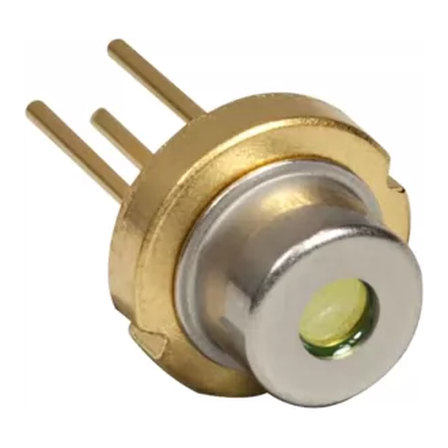
The TO38 direction provides a smaller TO metal package for a 905 nm pulsed transmitter. The closest catalogue platforms are PLD905-40W-MCL and PLD905-70W-M. The exact TO38 suffix, pin option and optical window must be confirmed against the controlled datasheet.
Why use a compact TO38 transmitter?
- More room in a glasses temple, frame or miniature ranging module.
- A shorter optical axis for transmitter, collimation and receiver integration.
- FAC compression to reduce the external fast-axis capture requirement.
- A small emitter as a starting point for a narrow transmitter beam.
- A practical component route for short-to-medium-range active sensing.
A smaller package does not automatically increase complete-system range. Pulse energy, divergence, receiver aperture, detector sensitivity and signal processing still set detection performance.
Typical 40 W platform
| Parameter | Typical value | Engineering meaning |
|---|---|---|
| Peak wavelength | 905 nm | Matches common silicon APD/SPAD receivers |
| Spectral width | 7 nm FWHM | Used in filter and thermal-drift budgets |
| Peak optical power | 40 W | 37-44 W listed range |
| Threshold current | 0.75 A | Low-current behaviour still needs validation |
| Operating current | 12 A | Standard condition: 100 ns, 3 kHz, 25 C |
| Operating voltage | 12.6 V | Driver compliance must cover pulse overshoot |
| Emitter | 40 x 18 um | Not the target-plane spot size |
| Slow-axis divergence | 9 degrees FWHM | Used with the external collimator |
| Fast-axis divergence | 6 degrees FWHM | Reduced capture requirement with FAC/MCL |
| Maximum pulse width | 100 ns | Intended for short-pulse operation |
| Maximum duty cycle | 0.1% | Pulse width, repetition and temperature must be combined |
Use the peak-power calculator, duty-cycle calculator and spot-at-distance calculator to check the operating point.
AI glasses
AI glasses use active ranging for object distance, interaction and obstacle feedback. A TO38 transmitter may fit inside a temple or frame, but the design should also verify:
- Optical-axis alignment against cameras, IMUs and displays.
- Accessible laser exposure during normal wearing conditions.
- Pulse energy and receiver SNR at low average power.
- Frame thermal paths and surface temperature.
- Drop, sweat, humidity and vibration reliability.
For short-range high-repetition operation, build the optical link budget rather than increasing peak power blindly. The LiDAR link-budget calculator is a useful starting point.
Golf rangefinding
Golf flag locking depends on separating the flagpole from trees, grass and background terrain. A narrow transmitter beam, controlled receiver field of view and target-selection algorithm work together. TO38 and FAC optics can support a compact transmitter path, but the final spot is set by the complete optical assembly.
Check target-plane spot size, receiver field of view, response time, background rejection, temperature drift and complete-product eye safety. The far-field LiDAR spot calculator helps estimate the collimated beam footprint.
Integration checklist
- Verify package drawing, pin polarity, window direction and optical datum.
- Measure pulse current, voltage, edges, width and overshoot on the real driver.
- Measure source and target-plane spots, not just divergence angles.
- Test wavelength and power drift across the operating temperature range.
- Validate the frame or product for heat, vibration, drop and long-run stability.
- Classify the complete product using its actual pulse energy, repetition and optics.
Products: PLD905-40W-MCL and PLD905-70W-M. The final TO38 configuration must follow the ordered datasheet and sample drawing.
Продукция
Связанные изделия
 Корпус TO56
PLD905-40W-MCL
905 нм, пиковая мощность 40 Вт, коллимация по быстрой оси
Корпус TO56
PLD905-70W-M
905 нм, пиковая мощность 70 Вт, без коллимации
Калькуляторы
Рассчитать по этой спецификации
Каждый калькулятор ниже открывается с уже подставленными паспортными значениями этого компонента в единицах соответствующих полей.
Пиковая мощность импульса
Инженерный калькулятор для расчёта пиковая мощность импульса и оценки влияния входных данных на результат.
Основы лазеровСкважность и тепловая нагрузка
Инженерный калькулятор для расчёта скважность и тепловая нагрузка и оценки влияния входных данных на результат.
Основы лазеровРазмер пятна на расстоянии z
Инженерный калькулятор для расчёта размер пятна на расстоянии z и оценки влияния входных данных на результат.
Дальнометрия и LiDARПятно LiDAR в дальней зоне
Инженерный калькулятор для расчёта пятно lidar в дальней зоне и оценки влияния входных данных на результат.
Дальнометрия и LiDARЭнергетический бюджет LiDAR
Инженерный калькулятор для расчёта энергетический бюджет lidar и оценки влияния входных данных на результат.
Смежные материалы
785 нм многомодовый лазер с гомогенизированным волокном: равномерное освещение, оптика тотальной станции и ограничения валидации
Практическое руководство по лазеру с гомогенизированным волокном 785 нм, 90 мВт, 200/340 мкм, включая равномерность освещения, вспомогательную оптику тотальной станции, бюджет мощности и измерение.
Оптика905 нм Раман DTS: отчет по инженерной реализации и валидации
Полный инженерный путь от импульсного насоса 905 нм и примерно 870/943 нм Раман-каналов через двойные APD, синхронное приобретение, коррекцию дифференциальных потерь, температурную инверсию, калибровку и проверку прототипа.
Руководство по выбору905 нм, 1535 нм или 1550 нм: выбор длины волны для дальнометрии и LiDAR
Выбор длины волны определяет детектор, класс лазерной безопасности, максимально допустимую энергию и поведение в плохую погоду. Вот как три диапазона реально сравниваются в дальнометрии.