Rangefinding scope teardown
Anatomy of a laser rangefinding scope
A rangefinding scope is four subsystems and one optical budget: the day-optics you aim through, the laser that measures, the detector that receives the return, and the electronics that time it. Pick a part from the bill of materials and drop it on the scope - each parameter comes with the catalogue parts that carry it.
- 1부품표에서 부품 하나를 고릅니다.
- 2모듈 위에 놓거나 카드를 그냥 클릭합니다.
- 3그 역할과 파라미터, 그리고 이를 담당하는 모델명을 읽습니다.
부품표
모든 부품이 하나의 광학 버짓 안에 있습니다. 카드를 사진 위로 끌어 놓거나 클릭하십시오. 옆 패널이 그 부품의 파라미터로 채워집니다.
여기로 부품을 끌어 놓기 또는 부품표에서 카드를 클릭
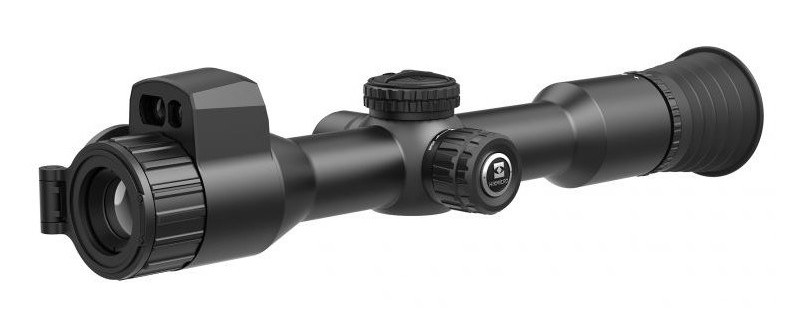
Objective on the left, eyepiece on the right. The two windows on the bay above the objective are the transmit and receive apertures; the driver and timing electronics sit in the saddle under the turret housing.
부품 위치는 교육용 도식이며 조립도가 아닙니다. 배치와 분해 보기는 참고용입니다. 파라미터 값은 링크된 사양의 값입니다.
모든 부품을 파라미터별로
인터랙티브 보기와 같은 수치를 읽고 검색하고 인용할 수 있는 표로 정리했습니다.
905 nm laser diode Transmitter
Emits the ranging pulse through the window above the objective. Peak power, pulse width, divergence and emission timing together set the reach and the power budget of a battery-powered device.
| Peak wavelength | 905 nm (895 - 915 nm) |
|---|---|
| Peak output power | 40 - 600 W |
| Pulse energy @ 100 ns | 4 - 30 uJ |
| Beam divergence, FWHM | 9 x 25 deg bare | 9 x 6 deg FAC |
| Pulse width | 1 - 100 ns (max 100 ns) |
| Duty cycle, max | 0.1 % |
| Repetition rate | up to 10 kHz |
| Package | TO56 | metal stack | bare die |
| Operating temperature | -40 to +85 C |
| Eye-safe alternative | 1535 nm, >= 40 uJ up to 1 mJ |
Avalanche photodiode Receiver
Sets how faint a return the scope can still see. Sensitivity has to be read together with responsivity, gain, dark current, bandwidth, bias stability and the receive aperture - never as one number.
| Response spectrum | 400 - 1100 nm |
|---|---|
| Wavelength | 905 nm |
| Active diameter | 230 um | 500 um | 16 elements |
| Responsivity | 80 A/W @ M=100 |
| Response time | 0.5 ns |
| Dark current | 0.4 nA @ M=100 |
| Total capacitance | 1.0 pF @ M=100 |
| Optimum gain | 100 |
| Reverse breakdown voltage | 100 - 200 V |
| Voltage temp. coefficient | 0.9 - 1.4 V/C |
| Optical filter | 905 nm spike filter | band-pass |
| Package | TO-46 | LCC1 / LCC2 ceramic | linear array |
| Eye-safe alternative | InGaAs APD at 1550 nm, 9.5 A/W at M=10 |
Day and ranging optics Optics
Magnification, field of view and eye relief come from the objective and eyepiece; the two ranging windows set the transmit divergence and how much of the return reaches the detector.
| Optical channels | 2 ranging (transmit + receive) + observation path |
|---|---|
| Aperture size (w x h) | 110 x 30 um |
| Transmit beam, bare | 9 x 25 deg FWHM |
| Transmit beam, FAC | 9 x 6 deg FWHM |
| Receive aperture / focal length | Set by your mechanical design |
| Receive filtering | 905 nm band-pass at the detector |
| Windows on the bay | 2 |
Control and timing electronics Electronics
Decides the pulse shape - width, rise time, jitter - and the receive bandwidth. Those two numbers are what the range resolution is actually made of.
| Peak pulse current | 70 A |
|---|---|
| Pulse width | 50 ns - 1 us adjustable |
| Repetition rate | 1 kHz - 30 kHz adjustable |
| Rise time | 7.5 ns typical |
| Fall time | 12 ns typical |
| Supply voltage | 12 V DC |
| Laser drive voltage | 1 - 50 V DC |
| Control interface | Internal trigger / external TTL |
| Factory default | 100 ns @ 3 kHz, internal trigger |
| Eye-safe driver option | 1535 nm: 10 A / 30 A pulsed, 1 / 5 / 10 Hz |
이 페이지의 모든 파라미터 값은 링크된 제품 페이지를 생성하는 카탈로그 기록에서 가져오므로 둘이 어긋날 수 없습니다.
이 파라미터를 뒷받침하는 부품
아래 모든 수치는 링크된 제품 페이지를 생성하는 것과 동일한 카탈로그 기록에서 읽습니다. 이 페이지에서 다시 적은 값은 없습니다.
905 nm transmit chain
Pulsed 905 nm sources from 40 W to 600 W in TO56 and metal stack, plus the bare die families for a build that makes its own emitter.
Eye-safe transmit chain (1535 nm)
The same four subsystems, with the transmitter moved to 1535 nm so the beam that leaves the scope is absorbed before it reaches the retina. Range is traded against size and repetition rate.
Receive chain
Silicon APDs at 905 nm - two active areas, two ceramic package families and a 16-element array - plus the InGaAs part that pairs with a 1535 nm transmitter.
Drive and timing
A 70 A nanosecond driver board with the timing generator already on it, and the 1535 nm drivers for an eye-safe build.
Aiming and illumination optics
For builds that add a visible beam or a fibre-delivered channel alongside the invisible ranging path.
This scope is the 905 nm / pulsed / rangefinder scenario
Run the selector with application = rangefinder, wavelength = 905 nm and output = pulsed and it returns the transmit chain listed below. For a longer reach, or for a build that has to be eye-safe, the same four subsystems take a 1535 nm transmitter and a 1550 nm receiver - the catalogue carries both chains.
Scope optics and the eye-safe option
Tell us the range, the target and the size limit. We come back with the transmit chain, the receiver and the optics between them - at 905 nm, or eye-safe at 1535 nm.